








Fed Will Wait and See for Now, Vote Less Next Year.
The Fed decided to take a break from hiking rates in October despite persistent price pressures as CPI and PPI continued to run much hotter than expected. Still, two FOMC members dissented to the pause, believing they needed to act to curtail inflation. The Fed plans to have fewer voting meetings in 2027 and 2028, altering the voting cadence that has been in place since the early 1980s. Prior to the meeting, the bond market had given the central bank some room to breathe, with 10-year yields sliding from 5.3% to a touch under 5% as they once again turned into a safe haven trade with recent the recent volatility in tech stocks. As we noted in our Weekly Market Review on October 23rd, that drop in yields is driving a recovery in stock market breadth with the average stock outperforming the S&P 500 and small caps bouncing back out of correction territory.
Earnings Season is Beating High Expectations, But Mag-7 Weighs.
The S&P 500 is on track to post 31.1% EPS growth on a 13.5% revenue gain versus preseason expectations for 24.5% and 12.2%, respectively. Likewise, the Russell 2000 is on pace for 9.8% revenue growth, edging out forecasts for 9.1%. While the run rate is extremely fast, it is still a touch slower than recent quarters, and key misses in the Mag-7 space are dragging on confidence somewhat. Financials results were uneven with surging yields taking a chunk out of FICC trading, though many noted the consumer is still resilient. Of the mega-caps to report thus far, SpaceX’s release was received the best with the stock rising 7.7% in the day after on surging AI revenues. Microsoft’s better than expected cloud revenue likewise pushed the stock higher in after-hours trading, though it dipped the following day. Meta beat earnings forecasts but the stock slid as free cash flow turned negative, while Tesla’s reduced capex plans raised investor fears that the company could fall behind in the AI race. Alphabet surprisingly missed both top and bottom line forecasts, posted its second consecutive quarter of negative free cash flow and slid more than 12% the following day. Amazon missed its earnings hurdle and said it spent more than forecast, driving negative free cash flow and a selloff the following day. So far, 2Q’s theme of beats with muted reactions given an extraordinarily high bar is repeating in 3Q as we outlined in our Market Sense on October 14th. Likewise, current valuations remain contingent on stocks at least meeting consensus forecasts, making this season critical to the bull market. See our Market Sense on October 13th for more.
IPOs are Back in the News with Anthropic Set to Go Public Before Thanksgiving.
Anthropic is looking to quickly dethrone SpaceX as the largest-ever IPO when it goes public sometime before Thanksgiving. Rumors suggest the company could seek up to $100 billion at a $1.5-2 trillion valuation and we examine possible effects to the market and its likely sector, tech in our Market Sense on October 29th. The issue would push 2026 close to 2021’s all-time record by deal value, though fears of an oversupply of shares are likely overblown given the reaction to SpaceX’s IPO. Still, like SpaceX disrupted the communications/telecom sector, Anthropic could take some wind from tech’s sails – especially if it’s seen as displacing legacy software stocks as was the case in the first half of this year.
Small Caps, Emerging Markets Hit Correction in Volatile October.
Equities were volatile in October. Small caps and emerging markets notably dipped into correction territory, but the Russell 2000 was able to pull out of its tailspin for now, following guidance from Treasury yields (see our Market Sense from October 22nd for more). At its worst, the VIX touched 20. For the month, small caps outperformed with value stocks leading the way, while emerging markets sunk more than 8% on tech trouble and political risk — pulling them neck and neck with US large caps. US small caps are now in the lead among major market segments year-to-date. Every Russell 3000 sector gained this month except for telecom and tech, with energy, staples and utilities on top.
Oil Prices Remain Elevated With No End to War in Iran in Sight.
West Texas Intermediate (WTI) crude closed the month just above $104/bbl, up more than 88% from the December low and in the 96th percentile since 1990. There are indications that the US and Israel are ready to resume strikes against Iran after the US midterms though recent reports that Iranian leadership is willing to resume talks lead to some relief to kick off November. Still, oil prices look to remain volatile for some time. Crude is already pushing headline inflation measures higher and denting the outlook for swaths of the S&P 500. The longer the conflict drags, the greater the potential fallout for markets.
Bond Markets Opened the Month Continuing the September Slide Before Rebounding.
After hitting a multi-year high of 5.36% early in the month, rates rallied to close the month just below 5% as cash flowed into treasuries from AI stocks. CoreWeave bonds blew out to 15%+ and Meta’s CDS found a record high after posting negative free cash flow, sending money to treasuries as a haven even as oil surged back above $100. Notably the September CPI print came in above expectations at 3.7% yet inflation expectations barely budged, pointing to real yields being the engine of the rate move. The Fed paused as widely expected with two members dissenting for a hike, futures markets are still pricing in a December hike. This month validated our focus on the belly of the curve as AI and fiscal stress kept the long end volatile.
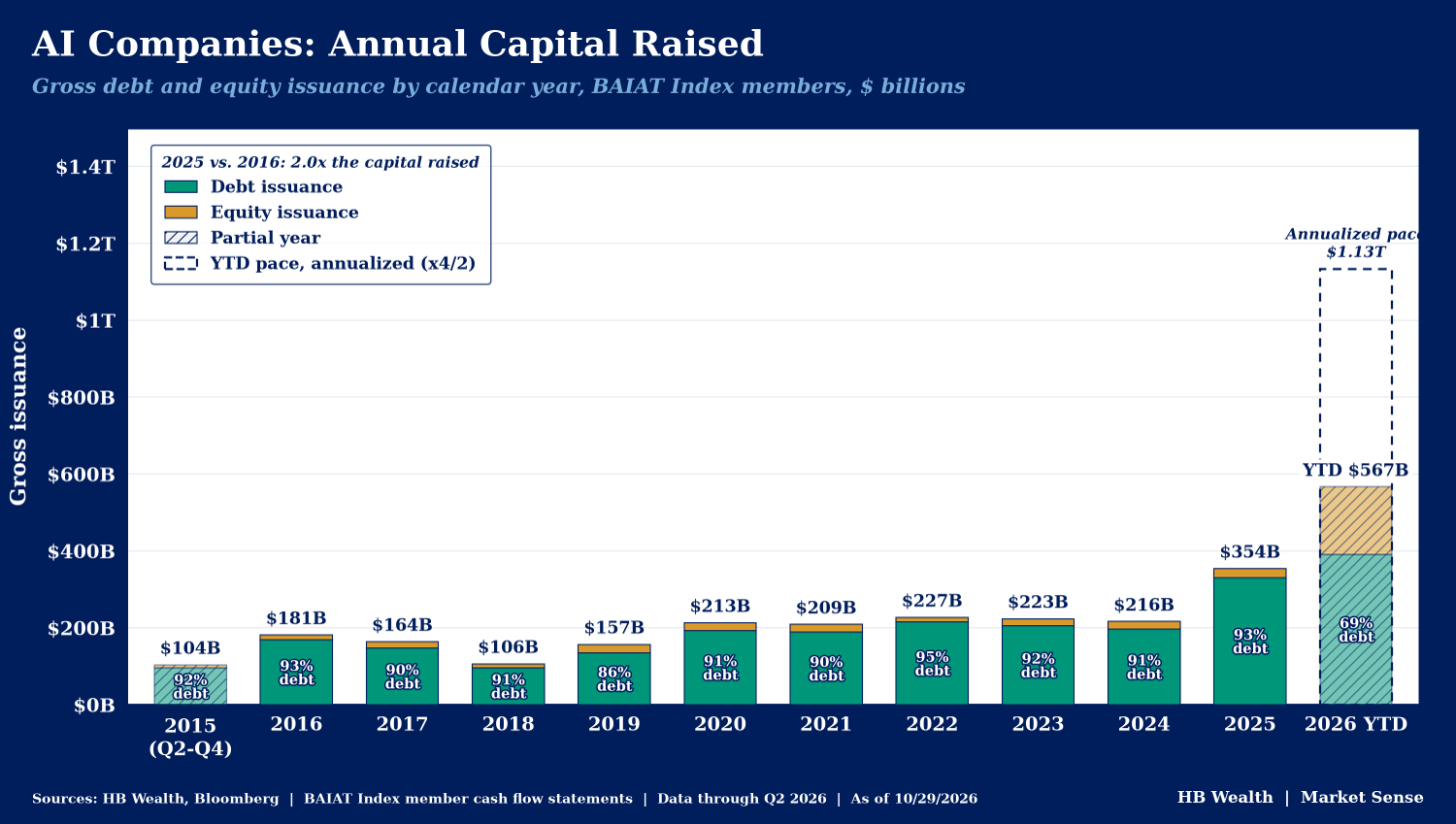
Chart of the Month:
Disclosure: HB Wealth is an SEC-registered investment adviser. The information reflects the author’s views, opinions, and analyses as the publication date. The information is provided for informational purposes only and does not constitute an offer to sell or a solicitation of an offer to buy any investment product. This information contains forward-looking statements, predictions, and forecasts (“forward-looking statements”) concerning the belief and opinions in respect to the future. Forward-looking statements involve risks and uncertainties, and undue reliance should not be placed on them. There can be no assurance that forward-looking statements will prove to be accurate, and actual results and future events could differ materially from those anticipated in such statements. The information does not represent legal, tax, accounting, or investment advice; recipients should consult their respective advisors regarding such matters. Certain information herein is based on third-party sources believed to be reliable, but which have not been independently verified. Past performance is not a guarantee or indicator of future results; inherent in any investment is the risk of loss.