








Abstract:
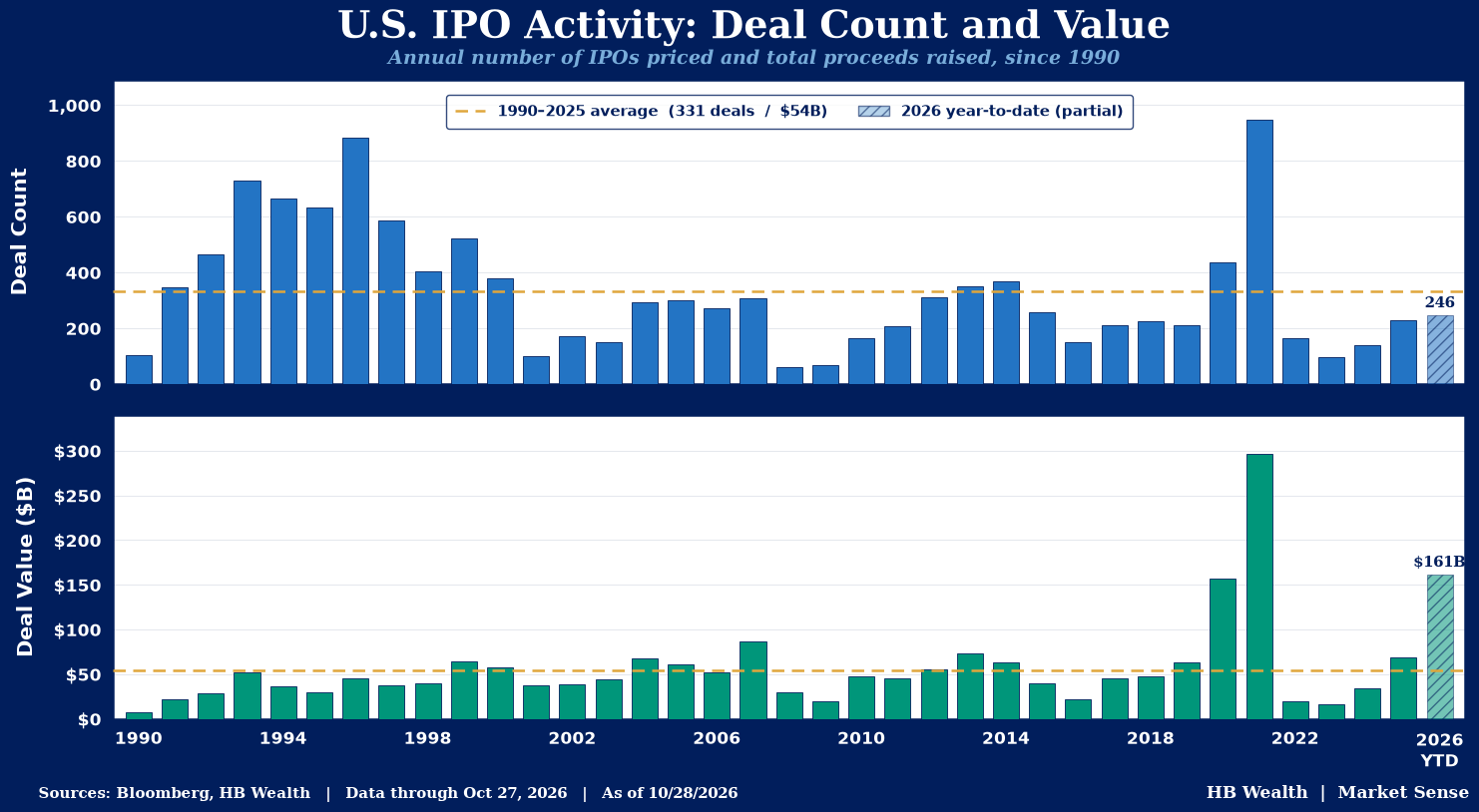
- 2026 is already the second-best year for IPOs (by value raised) and Anthropic’s issue will pull it closer to 2021’s record.
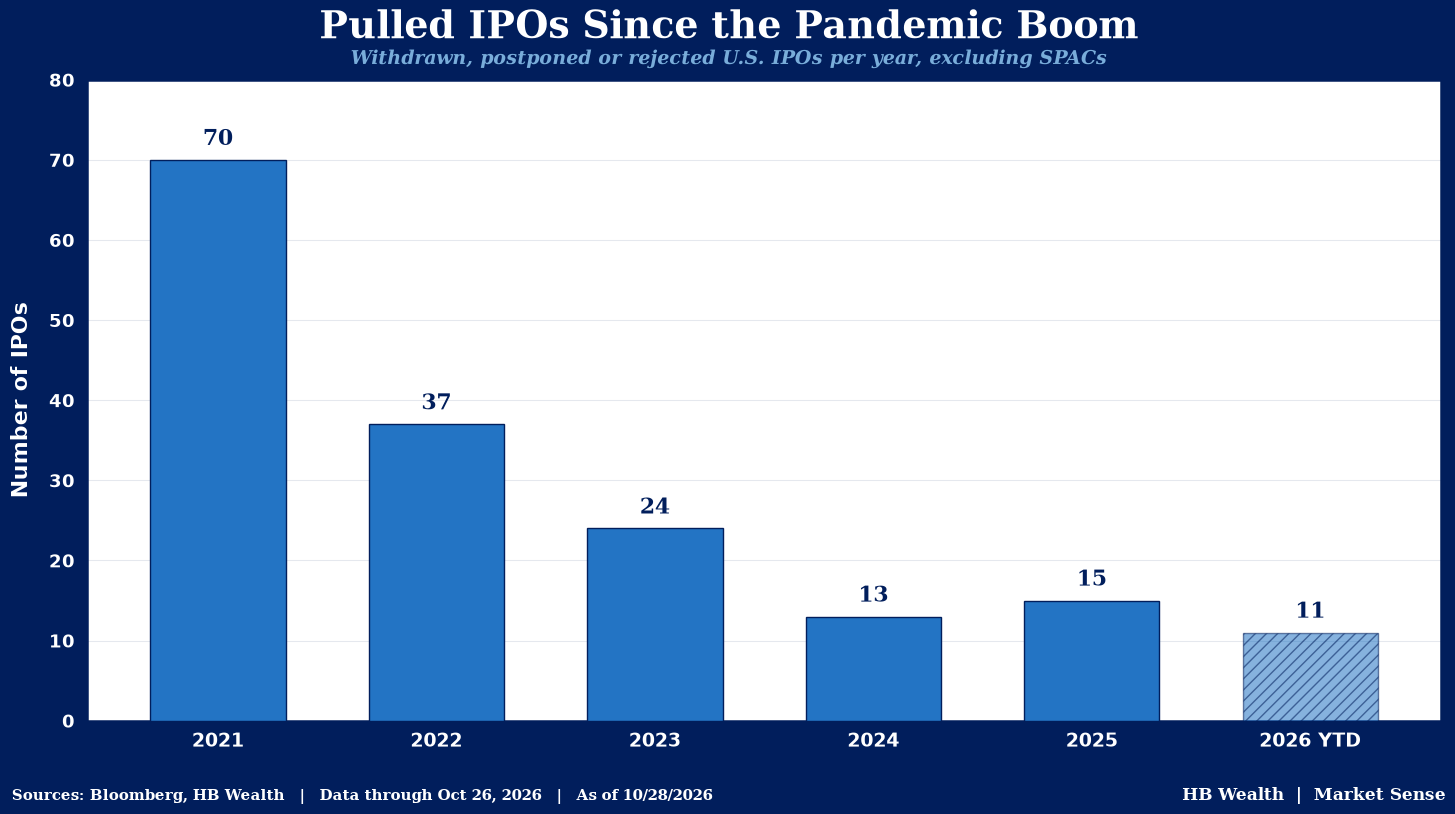
- Despite a spate of high-profile IPO postponements, fewer stocks have pulled listings than in the recent past. Neocloud IPOs certainly face a challenging environment, but most of those listings were outside the US. The others that postponed issues were scared off by volatility and uncertainty around rates this autumn.
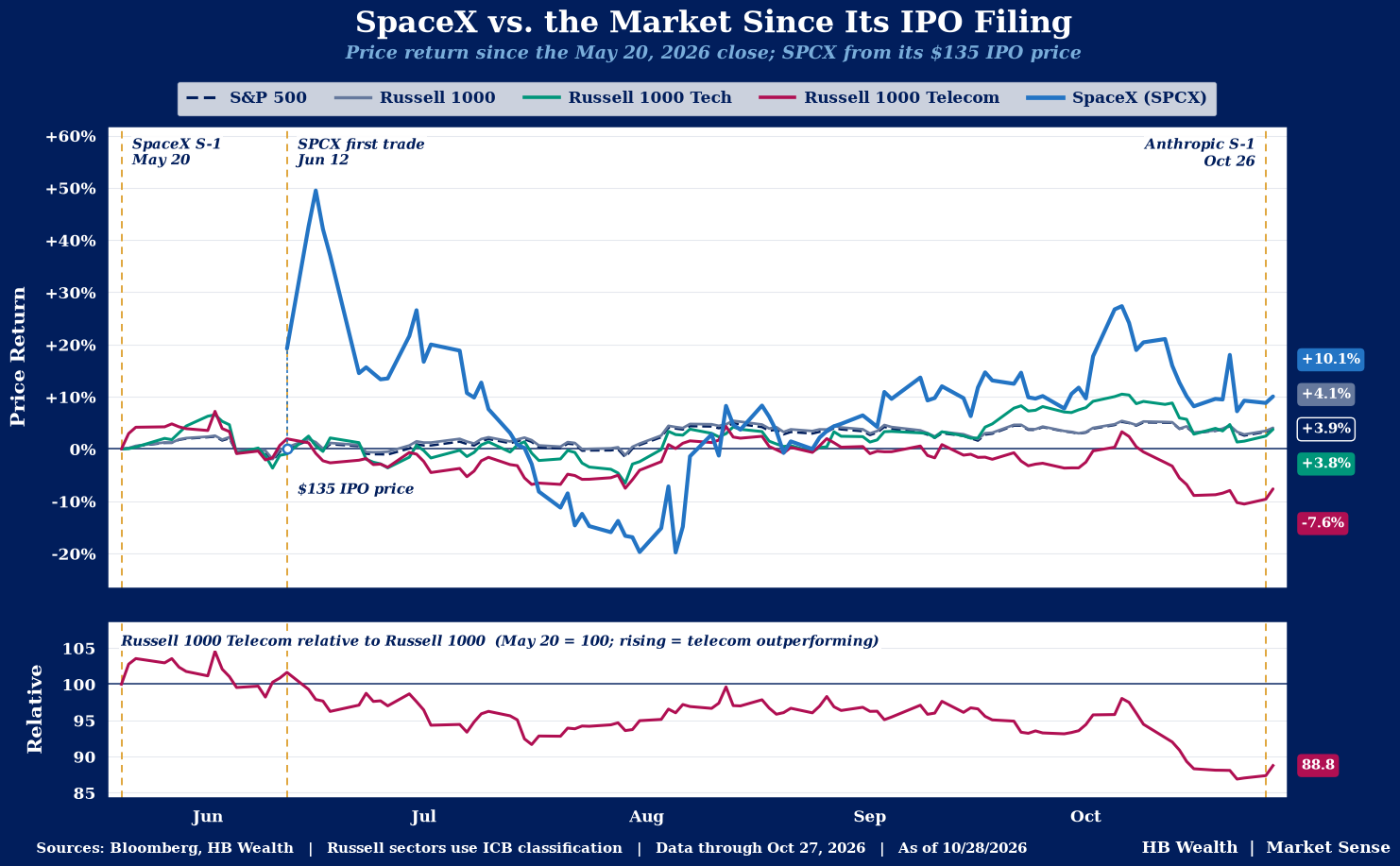
- Concerns about oversupply of shares have made headlines. Though SpaceX did little to derail stocks’ momentum, it certainly disrupted telecom stocks. Anthropic could force a similar market reaction with some competitive disruption across tech.
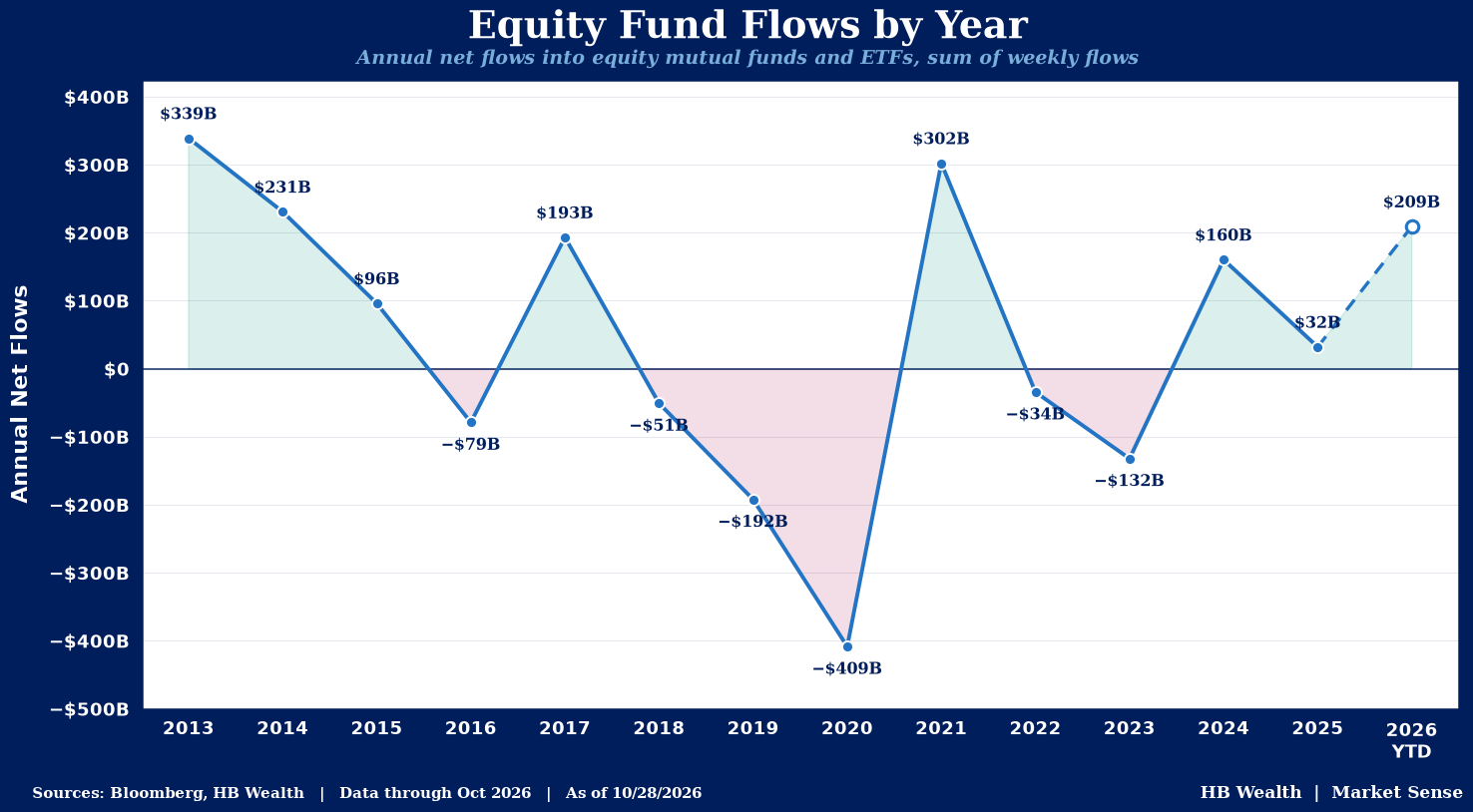
- Equity inflows have been robust all year and June – the month SpaceX IPOed – was one of the strongest periods, suggesting the market should be able to digest Anthropic’s rumored $100 billion IPO.
The IPO calendar has cooled a touch recently but is still on track to be the second-best year on record, with Anthropic set to IPO sometime before Thanksgiving as the second $1+ trillion company to issue in the U.S. this year. Initial rumors are that the company could seek up to $100 billion from the filing at a valuation that could push $2 trillion. With 2026 already the second-best year for IPOs by value – 246 companies with over $161 billion raised is just shy of 2021’s high watermark of 949 companies and $296 billion – Anthropic could push the year close to the record. A few high-profile stocks have pushed their filings out to 2027 with Oura and OpenAI at the forefront, likely leaving this year just shy of the record, but offering a spark to 2027’s issuance. Whether those companies will IPO sooner or later could come down to how Anthropic’s issuance is received by the market.
Higher Rates, Market Volatility Drove Canceled IPOs
The spate of canceled US IPOs over the late summer got a lot of headlines, but most aren’t postponing due to a slowing AI trade. There is some merit to the assertion that concerns around the neoclouds are hurting IPOs in that space. As CoreWeave’s bonds trade at deeply distressed levels, Firmus – an Nvidia backed Australian neocloud company – withdrew its IPO this month and Nscale’s IPO is delayed following construction setbacks, valuation disputes and SEC comment review.
This was a small part of the story of the slowdown in issuance, as the bout of volatility the market faced in the late summer and early fall – with market breadth collapsing – and newfound uncertainty around rate hikes seemed to be the more common thread. In fact, just 11 traditional US IPOs have been postponed all year – well lower than the 70 in 2021 (which was the best year for IPOs on record) and the 37 and 24 in 2022 and 2023 as the Fed embarked on a rate hike cycle and equities became mired in a bear market. This dynamic of rising rates and market volatility have curtailed IPOs in the past – 2023 was the worst year for US IPOs on record as rates rose and a marked slowdown in issuance occurred as the Fed embarked on the 2015-18 hiking cycle. Of the 11 postponed IPOs, the most common theme was nuclear/data center power generation though sector exposures were quite diverse.
Worried About Oversupply of Shares? SpaceX Didn’t Derail Markets
There’s a popular narrative in the market that Anthropic’s likely largest ever IPO could bring an oversupply of shares that forces selling across other tech stocks. One doesn’t have to look far for a good historical comparison – SpaceX’s IPO in June. While that stock has struggled to reach its all-time high made just five days after going public, SpaceX did little to derail the rally in stocks at large – though communications faced some struggle. Recall that SpaceX did not enter the S&P 500 under fast track rules, but oversupply concerns would theoretically hit the market at large – since the IPO, the S&P 500 is up 4.4%, the Russell 1000 rose 4.2% and tech has gained 5%. While the SpaceX issuance coincides with some loss of momentum for communications stocks at large, the company spelled trouble for its sector only recently, with that group slipping 9.3% since mid-October as SpaceX’s Starlink is making moves into the US cellular market, causing a selloff in some of the largest telecom names. In fact, since SpaceX filed their S-1 on May 20th, Russell 1000 communications is down 5.6% while the index is up 4.1%. Thus, presuming Anthropic will issue as a tech company in the Russell 1000, it could pressure fellow tech names. A resumption of the SAASpocalypse trade from earlier in the year can’t be ruled out should the company disrupt legacy software stocks – and in fact it could be part of the reason tech stocks have broadly struggled of late.
Sector nuances aside, demand for equities remains strong, and has been enough to overcome the new supply of SPCX so far, as evidenced by flows and market performance in 2026. Throughout the year, US equity ETFs and mutual funds have pulled in nearly $210 billion in inflows. That’s the largest inflow since 2021’s $302 billion which also coincided with a spike in IPO activity. While April was the strongest month for equity flows, June was the second strongest month this year, with SpaceX’s IPO likely driving at least some of the interest in equities that month. Anthropic’s issue could be more of the same – while expected to be for $100 billion versus SpaceX’s $75 billion, excitement around the new IPO could bleed into the market in a similar fashion.
Anthropic to Follow Staggered Lockup Expiration
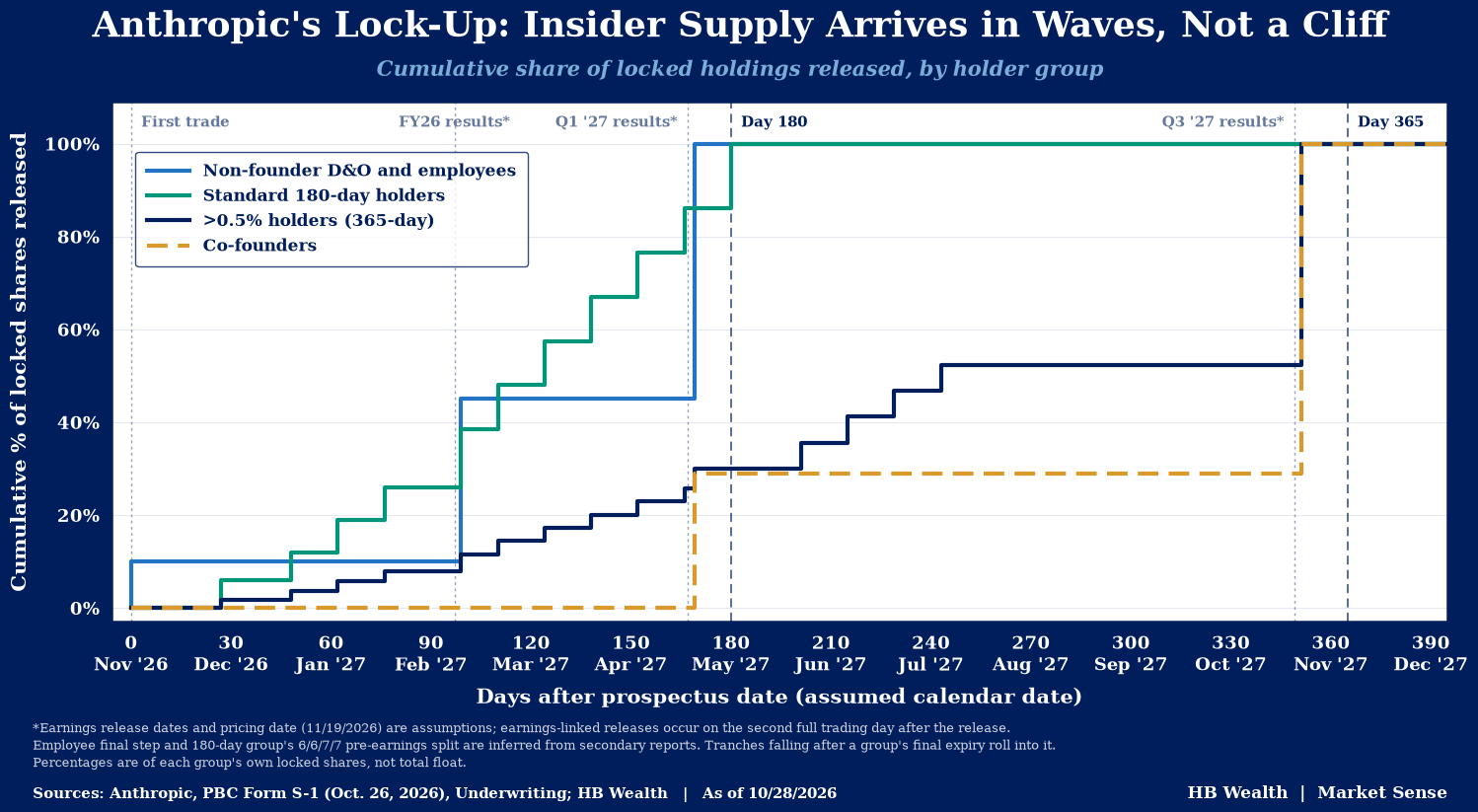
Like SpaceX, Anthropic’s lockup won’t follow a traditional 90- or 180-day schedule. Instead, the company will have staggered lockups, meant to drip out supply to equity markets and help the stock price remain relatively stable. Regardless, the stock is likely to enter most major US indices shortly after IPO as only S&P rejected fast-track rules to speed inclusion of mega-IPOs. Given the supposed $100 billion funding sought and $1.5-$2 trillion rumored valuation, the stock will certainly hit Nasdaq and Russell’s minimum float share requirements and given the size, that means the stock will hit those gauges 15 and 5 days post-IPO. When it does make the Russell 1000, it will likely start out as roughly the 116th largest stock based on float adjusted shares and could climb as high as fifth should it achieve a $2 trillion valuation and approach 100% of shares floated.
Disclosure: HB Wealth is an SEC‑registered investment adviser. The information reflects the author’s views, opinions, and analyses as the publication date. The information is provided for informational purposes only and does not constitute an offer to sell or a solicitation of an offer to buy any investment product. This information contains forward-looking statements, predictions, and forecasts (“forward-looking statements”) concerning the belief and opinions in respect to the future. Forward-looking statements involve risks and uncertainties, and undue reliance should not be placed on them. There can be no assurance that forward-looking statements will prove to be accurate, and actual results and future events could differ materially from those anticipated in such statements. The information does not represent legal, tax, accounting, or investment advice; recipients should consult their respective advisors regarding such matters. Certain information herein is based on third-party sources believed to be reliable, but which have not been independently verified. Past performance is not a guarantee or indicator of future results; inherent in any investment is the risk of loss.