









Understanding Family Offices: Responsibilities, Types, and Services
This comprehensive guide explores the key aspects of family offices, from their structure and functions to best practices for effective wealth management.
What is a Family Office? Its Purpose, Benefits, and How It Works
Family Office vs. Traditional Wealth Management
Unlike traditional wealth management services, family offices provide a holistic approach to managing generational wealth, offering bespoke solutions tailored to the specific needs of affluent families. These services often include investment management, tax planning, estate planning, philanthropy, and risk management.
The importance of a family office lies in its ability to centralize financial decision-making and implement actions to hopefully ensure long-term wealth preservation and strategic growth. By integrating a multidisciplinary approach, family offices help affluent families navigate the complexities of wealth management while addressing succession planning, governance, and legacy-building. Whether structured as a single-family office (SFO) serving one family, a multi-family office (MFO) catering to multiple clients, or an SFO/MFO hybrid approach that combines the elements of both, these entities play a crucial role in managing the financial affairs of a complex or multi-generational family.
This comprehensive guide explores the key aspects of family offices, from their structure and functions to best practices for effective wealth management. Whether you are considering establishing a family office or seeking to optimize an existing one, this resource will provide valuable insights to support your financial goals.
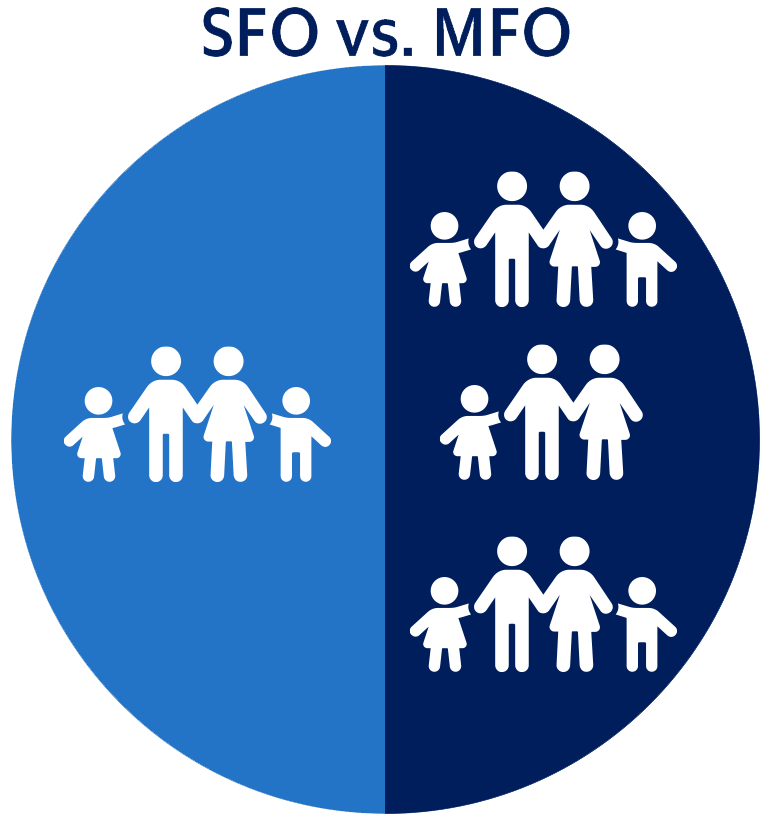
Explaining a Single-Family Office versus Multi-Family Office
When establishing a family office, one of the key decisions is whether to create an SFO, join an MFO, or possibly implement something in between (hybrid). Each structure offers unique advantages depending on the family’s wealth, complexity of needs, and desire for customization.
Single-Family Office (SFO)
A private office dedicated to managing the wealth and affairs of a single family.
Multi-Family Office (MFO)
A shared office that serves multiple families, pooling resources and expertise.
SFO/MFO (Hybrid)
A blend of in-house staff for select functions while outsourcing many significant investment and planning roles to an MFO advisor.
Single-Family Office (SFO)
Fully customized services tailored exclusively to the family’s needs.
Multi-Family Office (MFO)
Standardized or semi-customized services across multiple families.
SFO/MFO (Hybrid)
Selective customization—families retain control over key areas while leveraging MFO expertise for broader needs.
Single-Family Office (SFO)
High cost due to dedicated staff, infrastructure, and regulatory requirements.
Multi-Family Office (MFO)
More cost-effective, as expenses are shared among multiple families.
SFO/MFO (Hybrid)
Flexible cost structure—families control in-house expenses while outsourcing complex functions to an MFO.
Single-Family Office (SFO)
Full control over decisions, investments, and operations. Maximum privacy.
Multi-Family Office (MFO)
Less direct control but benefits from professional management and economies of scale.
SFO/MFO (Hybrid)
Balanced approach—families maintain internal control over sensitive areas while benefiting from external expertise.
Single-Family Office (SFO)
Requires hiring and managing an in-house team of experts.
Multi-Family Office (MFO)
Access to a broad range of financial, legal, and tax experts without managing them directly.
SFO/MFO (Hybrid)
Families retain in-house specialists for core functions while using an MFO for investment, planning, and governance expertise.
Single-Family Office (SFO)
Must comply with regulatory requirements, reporting, and governance.
Multi-Family Office (MFO)
Compliance and operational burdens are managed by the MFO.
SFO/MFO (Hybrid)
Families handle compliance for in-house staff while outsourcing investment and regulatory oversight to an MFO.
Single-Family Office (SFO)
Ultra-high-net-worth families seeking full autonomy and personalized management.
Multi-Family Office (MFO)
High-net-worth families looking for professional management without the complexity of running a dedicated office.
SFO/MFO (Hybrid)
Families who want a tailored approach—maintaining some internal staff while outsourcing specialized functions to an MFO.
The decision between an SFO, MFO, or a hybrid depends on factors such as wealth level, family governance preferences, and the need for direct control versus cost efficiency or a combination of all of those factors.
Families with extensive assets and unique requirements may benefit from an SFO, while those seeking expert management with shared costs may find an MFO more suitable. Other families may decide that they want to internally source some areas while outsourcing others.
Single-Family Office (sfo)
Pros:
- Complete control & priority
- Dedicated, long-term staff
- Enhanced privacy
- Legacy & community engagement
Cons:
- High operational and staffing costs
- Requires significant time and oversight to manage effectively
- Greater regulatory and compliance burdens
- Limited external perspectives compared to multi-family collaboration
Multi-Family Office (MFO)
Pros:
- Cost efficiency & flexibility
- On-demand expertise
- Broader industry insights
- Institutional investment access
Cons:
- Less customization compared to an SFO.
- Shared services may not align with a family’s unique preferences.
- Reduced control over investment strategies and operational decisions.
- Potential confidentiality concerns due to multiple families being served by the same office.
Choosing between an SFO and an MFO depends on a family’s desire for control, cost considerations, and operational preferences. An SFO offers unparalleled autonomy, privacy, and dedicated service but requires significant financial resources and management responsibilities. In contrast, an MFO provides access to specialized expertise, cost efficiencies, and institutional investment opportunities while reducing the burden of hiring and overseeing a full in-house team. Understanding these trade-offs helps families determine the best structure to support their long-term financial and legacy goals.
Providing Multi-Family Office Key Services With a Single-Family Office Mindset
At HB Wealth, we offer your family the advantages of a multi-family office (MFO) structure, enabling you to share the costs of staff and systems with other family office clients. This approach provides you with the scale benefits of these investments and access to the collective expertise of multiple teams. A dedicated Wealth Strategist is integrated into your team, supporting estate planning and multi-generational issues without incurring billable hours—except when new legal documents are required.
Our service model aims to deliver the level of care and attention you would expect from a single-family office (SFO) while relieving you of the complexities and costs associated with building and maintaining an in-house team. Some clients choose to supplement their HB Wealth family office services team with dedicated staff for specific purposes, effectively avoiding the full investment of a complete SFO. The multi-family office model strikes an ideal balance for families seeking the sophistication of a large family office without the associated expenses and administrative burdens.
Unlike many advisors, HB is not driven by asset gathering or product sales. Our flexible fee structures are not solely dependent on assets under management, helping to ensure that our guidance remains objective and aligned with your best interests. We are not incentivized to recommend manager changes merely to increase fees; rather, our approach is the opposite—we focus on helping families optimize their financial decisions across all aspects of their wealth to achieve the best possible outcomes.
A family office’s investment strategy must align with the family’s financial goals, risk tolerance, and time horizon. Diversified asset allocation, private market investments, and impact investing are key considerations in building a resilient portfolio. A disciplined investment approach helps ensure sustainable wealth growth while adapting to market fluctuations and economic shifts.
Establishing a robust governance framework enhances transparency, accountability, and decision-making within the family office. Family constitutions, advisory boards, and regular meetings create a structured environment for managing wealth and resolving disputes. Strong governance fosters alignment among family members, ensuring that financial and legacy goals are upheld across generations.
Educating the next generation about wealth management, financial literacy, and family values is crucial for long-term success. Family offices often implement structured education programs, mentorship opportunities, and financial training to prepare heirs for future responsibilities. An informed and engaged next generation strengthens family unity and ensures a responsible approach to wealth stewardship.
Trusts and estate planning are fundamental to preserving family wealth and ensuring its seamless transfer to future generations. By establishing well-structured trusts, families can protect assets, minimize tax liabilities, and maintain control over wealth distribution. Estate planning strategies, including wills, power of attorney, and philanthropic giving, help align financial plans with the family’s legacy objectives. A comprehensive approach to trusts and estates provides security, efficiency, and continuity for wealth management across generations.
Family office clients often have a strong desire to give back, and their level of wealth enables them to make meaningful contributions, including the potential establishment of a private foundation. HB assists families in evaluating their philanthropic options, facilitating major gift discussions, and overseeing the giving process to ensure alignment with their mission, vision, and values.
Research from the Family Office Exchange indicates that the average family office spends 32% of its time collecting, verifying, analyzing, and consolidating financial data. Many families come to HB burdened by multiple managers, numerous statements and complex spreadsheets attempting to track their assets.
HB simplifies this process by providing comprehensive reporting across all investment assets—whether liquid or illiquid—eliminating the stress of financial organization. We meticulously track private investments, including contributions and distributions over time, ensuring accurate and up-to-date records. Our customized reporting system, available online or in print, presents a clear and consolidated view of your family’s financial landscape, tailored to your preferences and needs.
Our family office clients benefit from a high level of service that minimizes time spent on administrative tasks and paperwork, allowing them to focus more on enjoying their wealth and life. For those who opt for additional support, HB offers bill pay services for a supplemental fee, customized based on the required level of reporting and approval processes.
How to Evaluate a True Multi-Family Office (MFO Provider)
Not all MFOs provide the same level of service as an SFO. Many firms use the term “family office,” but do they truly offer the expertise, integration, and alignment a family needs? Consider these key factors:
- True Expertise A real MFO has in-house specialists in estate planning, tax strategies, risk management, and complex portfolio management, not just a generalist advisor.
- Advice Integration Beyond offering multiple services, a strong MFO ensures seamless coordination across legal, tax, investment, and family governance needs.
- Fiduciary Commitment Some firms are only fiduciaries part of the time. Ensure the MFO always adheres to a fiduciary standard—like an SFO would.
- Avoiding Conflicts of Interest Even fiduciary firms can have conflicts. If an MFO profits from selling products (insurance, lending, proprietary funds), their advice may not be fully objective. A true MFO prioritizes transparency and avoids such conflicts.
Why HB Wealth for Family Office Services?
At HB Wealth's Family Office division, we built our firm to reflect the level of service, transparency, and expertise that our clients would expect if they designed their own ideal wealth advisor. Our approach—Wealth Management Built For You®—ensures that we serve our family office clients with:
- A deep bench of specialists covering investments, tax, estate planning, and risk management.
- A fully integrated advisory approach, aligning all aspects of your financial picture.
- A fiduciary obligation to act solely in your best interest.
- A fee-only service model, seeking to avoid incentives that could compromise our advice.
As you evaluate your family office options, we encourage you to consider these critical factors and reach out to discuss how HB Wealth's family office services may be the right fit for your complex family needs.





This material is not a recommendation, offer, or solicitation to sell or purchase any security. There can be no guarantee that investment objectives will be achieved. All investing involves risk.