








Chart of the Month:
Economy is Coasting, But Inflation Remains a Thorn in the Market’s Side
Indicators of economic growth remain solid but price inflation remains well ahead of the Fed’s target and it is perpetually pestering both equity and bond markets. Employment appears to be strengthening, aiding the growth outlook but likely adding fodder for continued demand-side inflation. Likewise, services and manufacturing PMIs remain in expansion and GDP is firing on all cylinders except for trade. Inflation, however, remains well above target and Fed Chair Warsh’s jawboning has done little to calm markets – following his press conference on July 29th, long duration Treasuries climbed, reflecting higher embedded inflation expectations. Equities likewise may show lingering concerns about the direction of rates as we detail in our Market Sense here.
Stocks Slide as Growth Style Implodes
Stocks fell 0.5% in July as high momentum and growth stocks continued to give back some of their blistering April-May rally. For the month, US small caps slid the most with the growth style a major drag across capitalizations, down roughly 5% in the Russell 3000 and posting its worst month versus value since 2001. Momentum, however, was the largest weight on equities, falling nearly 8% in the Russell 3000. Conversely, value, quality and defensive stocks rallied. Similar trends were notable across sectors with an odd combination of cyclical value and defensives taking charge – energy, financials, real estate, staples, and health care led while tech, materials, telecom and industrials sharply underperformed. Our sector model currently leans toward energy, tech and materials and away from communications (telecom), real estate and financials. For more on that model’s construction and our qualitative take on its suggestions, see our Market Sense here.
Iran War Gets Headlines but Stocks are Still at the Mercy of AI
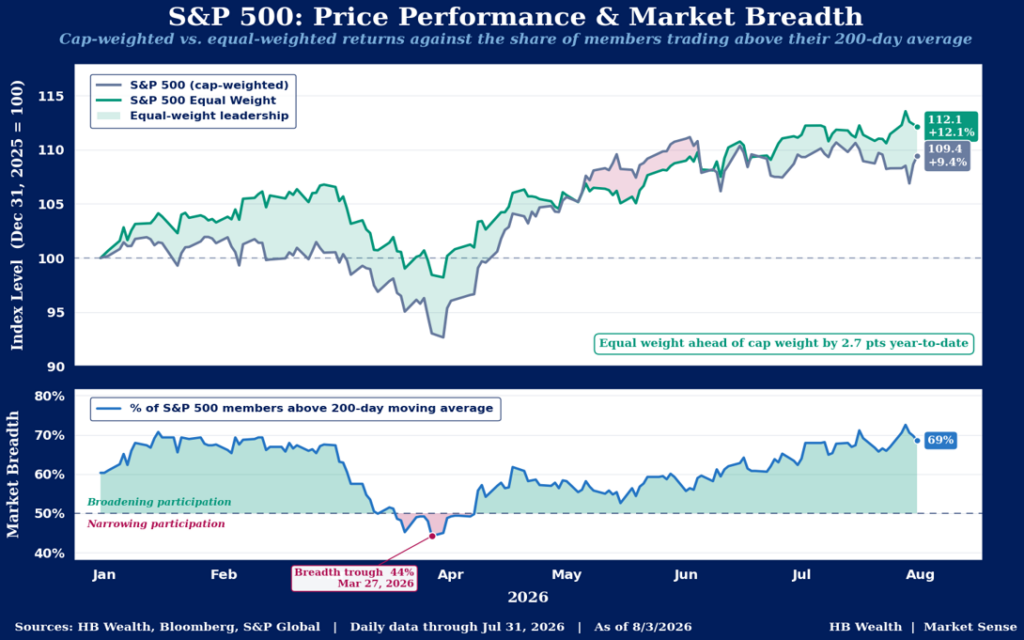
Though rapid momentum shifts in high-flying AI stocks are driving broad market cap weighted indices, most stocks in the market are still rising, exhibited by the fact that the equal weighted S&P 500 is still making new highs. Since large-caps’ high in early June, the average AI stock is down more than 14% while those not associated with the theme are up roughly 5%. Decelerating earnings momentum for the former could continue to pester equities as we detail in our Market Sense here.
Hyperscaler Capex, Free Cash Flow Are the Clear Pressure Points for 2Q Earnings
Earnings season is in full swing and S&P 500 companies are soaring over lofty hurdles, on track for a 29% earnings advance year-over-year (versus estimates for a 23.2% rise). Despite those solid large cap results, there’s been clear investor consternation toward higher-than-expected capex forecasts and free cash flow misses among the mag-7’s hyperscalers. Tesla, while missing its earnings bar, reported negative free cash flow amid faster capex than expected – while reaffirming the full year spending outlook – and the stock dipped. Likewise, Alphabet’s surprisingly negative cash flow (for the first time in the company’s public history) and Meta’s earnings miss paired with higher capex guidance sunk the two communications-sector giants. In contrast, Microsoft’s beat – headlined by its Azure cloud business and growing adoption of its Copilot AI – drove the stock up as free cash flow surprised while Amazon’s massive acceleration in AWS revenues allayed fears of its own misguided spending. We highlighted these growing pressure points in our Chart of the Week from July 24th.
Oil Remains Volatile as War Headlines Whipsaw Markets
West Texas Intermediate (WTI) crude oil has remained volatile throughout July, bottoming early in the month just below $70/bbl and topping out over $90 before ending the month around $84. While that’s substantially lower than the $113/bbl high hit in April, its still roughly 53% above the December high and in the 80th percentile back to 1995. Higher oil could hound 2H earnings reports and makes the Fed’s job a bit tougher as consumers suffer at the pump and headline inflation remains stubborn.
Bonds Bristle at Federal Open Market Committee (FOMC) Inaction
The FOMC held its target range this quarter for the fifth straight meeting, but it was the closest call in years. Three officials dissented in favor of a hike, the most dissents since 2016. Warsh called it a “good family fight”, and stripped forward guidance as expected. Markets now price a roughly 80% chance of a September hike and two more by mid-2027. The bond market prefers certainty and pushed the 30-year higher to roughly 5.20%, its highest since 2007, while the two-year yield fell roughly 10bps to 4.24%. The persistently high 30-year yield is being driven by a range of factors, including hints of increased coupon issuance vs the recent t-bill focus, competition for long dated capital with IG corporate issuance, and an erosion of faith in the Fed’s reaction function.
Disclosure: HB Wealth is an SECregistered investment adviser. The information reflects the author’s views, opinions, and analyses as the publication date. The information is provided for informational purposes only and does not constitute an offer to sell or a solicitation of an offer to buy any investment product. This information contains forward-looking statements, predictions, and forecasts (“forward-looking statements”) concerning the belief and opinions in respect to the future. Forward-looking statements involve risks and uncertainties, and undue reliance should not be placed on them. There can be no assurance that forward-looking statements will prove to be accurate, and actual results and future events could differ materially from those anticipated in such statements. The information does not represent legal, tax, accounting, or investment advice; recipients should consult their respective advisors regarding such matters. Certain information herein is based on third-party sources believed to be reliable, but which have not been independently verified. Past performance is not a guarantee or indicator of future results; inherent in any investment is the risk of loss.