








Abstract:
- The primary driver of equities has clearly shifted back toward AI as the boom in AI stocks in April and May has partly reversed in June and July.
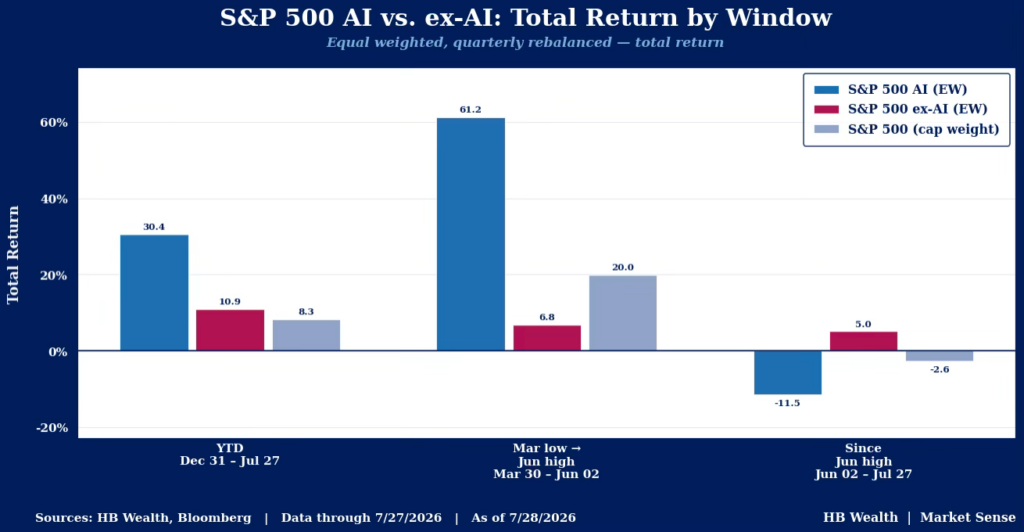
- The average AI stock in the index is down 14.4% while the average non-AI stock is up 5.0% from the early June peak in the market. Thus, while the total market is down 2.6% on a cap weighted basis since its June 2 high, it is up 3.2% on an equal weighted basis.
- As the year progresses, we expect decelerating earnings momentum among AI-focused companies may weigh on stocks most closely tied to the theme, and this may limit return prospects for large cap US stocks. Improving earnings momentum among non-AI companies may continue to offset the drag.
- Importantly, while earnings growth rates may be peaking, net income linked to AI is still on the rise and is expected to remain more than 40% of S&P 500 income in the year ahead.
- Also, not all AI stocks can be painted with one broad brush as the AI cycle itself continues to evolve. Semiconductors may have to digest peak growth, but other segments of the theme may be touching a growth trough.
The on-again off-again war between the US and Iran, rising bond yields in the face of sticky inflation pressures, and uncertainty around the future of Fed policy may all continue to have some impact on stocks, but the primary driver of equities has clearly shifted back toward AI this summer. As the year progresses, we expect decelerating earnings momentum among AI-focused companies may weigh on stocks most closely tied to the theme, and this may limit return prospects for large cap US stocks. However, companies that are not the primary purveyors of AI may continue to post accelerating growth. Also, there is nuance to consider, for net income linked to AI is still on the rise – its pace of growth may simply slow from extreme to still-strong. Likewise, not all AI stocks can be painted with one broad brush as the AI cycle itself continues to evolve.
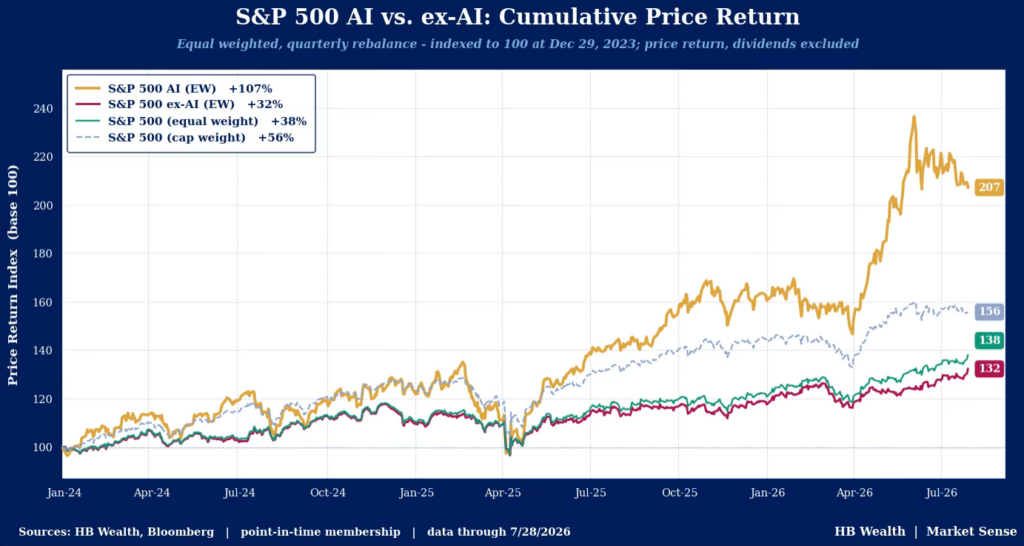
On an equal-weighted basis, the basket of AI stocks in the S&P 500 is up more than 30% this year, and the median AI stock in the S&P 500 is up 19.2%, outpacing the average S&P 500 stock’s price gain by 950 basis points year to date. However, the return for the AI was driven entirely by the April-May bounce in shares. During that two-month stretch, the AI basket posted a return of more than 60%, while the equal weighted return for the S&P 500 ex-AI was just 7%.
From the late March low to the early June high, a disproportionate share of the S&P 500 gain came from stocks tied to the AI theme, and the correction since early June has likewise been focused on unwinding some of that extraordinary gain. The S&P 500 at large is down 2.6% from its June 2 peak, but the S&P 500 is UP 3.2% on an equal weighted basis, and up 5.0% excluding the 45 stocks that are AI-focused. The average AI stock in the index is down 14.4% while the average non-AI stock is up 5.0% from that June peak. Also, 91% of the stocks in the AI basket have dropped since June 2, while ex-AI, only 29% of stocks have posted a decline over that time.
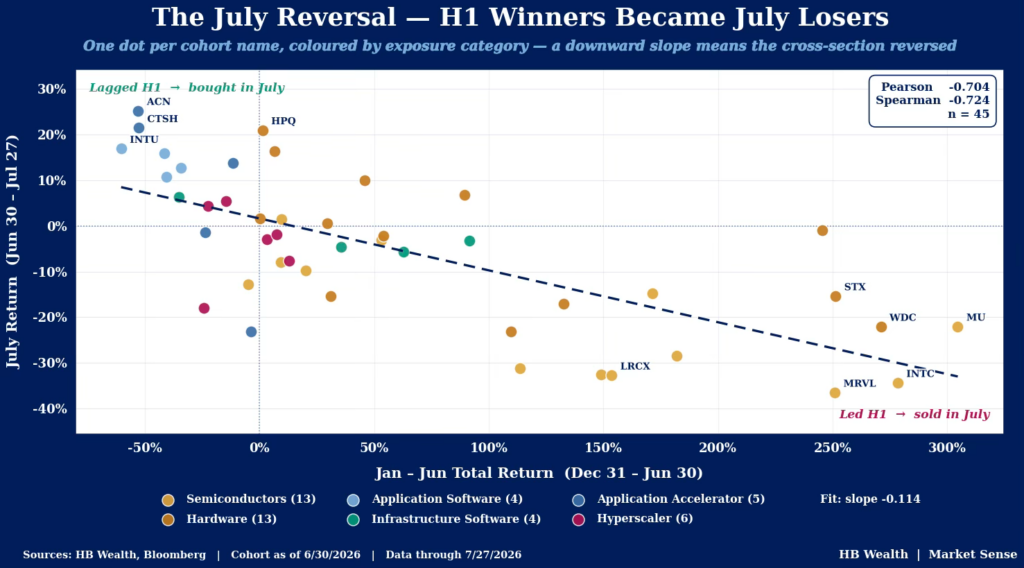
As shown in the scatter plot below, the recent sell-off in AI stocks has been largely a mere reflection of the April-May rally. In many cases, the stronger the rally in the first half of the year, the stronger the recent sell-off in shares. This surge and sell-off dynamic was most profound within the semiconductor and hardware segments of the AI theme. The median AI-semiconductor stock return was 48.9% in April-May and has been -9.7% in June-July, for example, while the median AI stock posted a return of 31.7% in April-May but -8.4% in June-July.
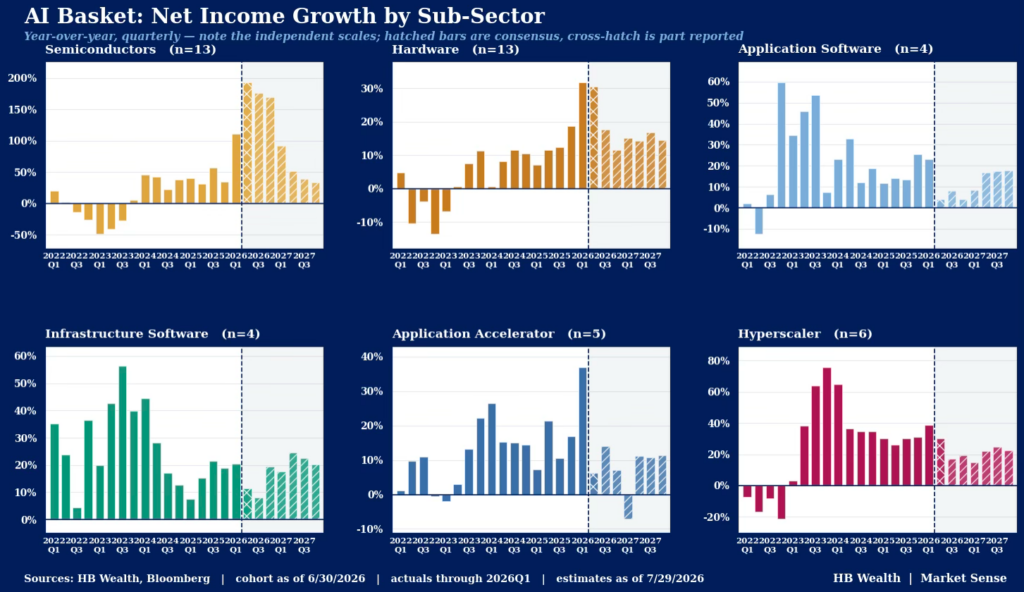
There is a fundamental momentum driver of this sudden price shift – AI stocks at large may be hitting peak earnings growth. This has happened before – AI earnings growth peaked in early 2024, and the subsequent minor slowdown in growth temporarily took the wind out of the sails of the AI trade in late 2024 and early 2025. It wasn’t the end of the trade, but a mere disruption, as the reacceleration in earnings growth for the theme at the start of 2026 reinvigorated share prices. If AI-stocks earnings momentum once again wanes, price momentum may remain somewhat constrained until a clearer path for the next burst of earnings momentum emerges.
This may in turn put the onus on non-AI segments of the index to carry both fundamental and price momentum for the broad market for the near term as AI momentum slows. If consensus is correct, the non-AI segments of the index should manage to post accelerating earnings growth through at least the third quarter of this year. This recovering momentum in non-AI earnings likely helps explain how the equal weighted index can continue to make new highs amid the AI-stock sell-off.
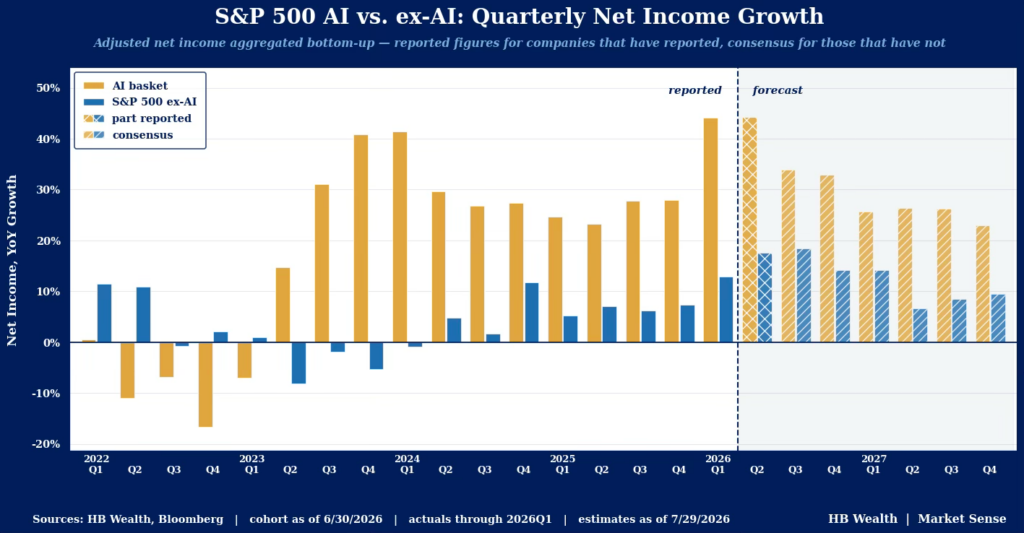
Notably, AI earnings are still expected to rise, suggesting this is not likely the end of the fundamental story that has driven markets in the post-pandemic era. While growth rates are likely peaking, there is no sign of significant fundamental slowdown for AI-focused segments of the index – it’s just a matter of a slower rate of growth emerging after a period of extraordinary gains. After posting $935 billion in net income in 2025, or 36.9% of broad S&P 500 net income, AI stocks are expected to post $1.3 trillion in net income in 2026, or 41.1% of the index total. In 2027, net income is still expected to boom, at $1.6 trillion, but this will likely remain a very high share of index income, at 44.4%. Stock price movements are now likely starting to reflect slower growth, but the still-elevated share of overall index earnings is notable and should not be ignored.
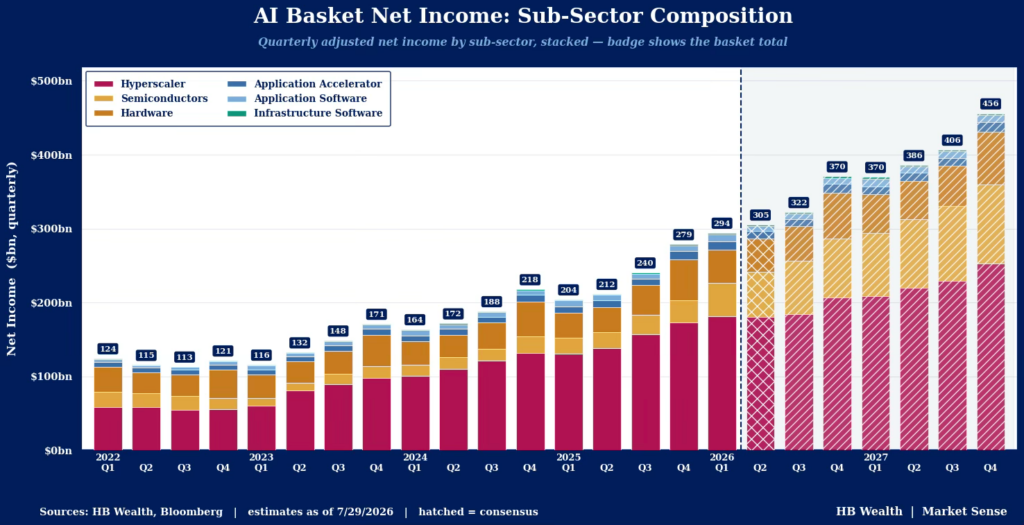
It is also worth noting that all AI stocks should not be painted with one broad brush, as the sub-segments within the AI trade are not all on the same earnings cycle. While the bulk of the AI theme, represented by semiconductors and hardware, may be experiencing peak earnings growth, other segments, like infrastructure and application software, may be set to hit trough earnings growth in the near term, with hyperscalers not far behind. This may allow for rotation toward new segments within the AI theme itself as spring’s high-flyers adjust.
Disclosure: HB Wealth is an SECregistered investment adviser. The information reflects the author’s views, opinions, and analyses as the publication date. The information is provided for informational purposes only and does not constitute an offer to sell or a solicitation of an offer to buy any investment product. This information contains forward-looking statements, predictions, and forecasts (“forward-looking statements”) concerning the belief and opinions in respect to the future. Forward-looking statements involve risks and uncertainties, and undue reliance should not be placed on them. There can be no assurance that forward-looking statements will prove to be accurate, and actual results and future events could differ materially from those anticipated in such statements. The information does not represent legal, tax, accounting, or investment advice; recipients should consult their respective advisors regarding such matters. Certain information herein is based on third-party sources believed to be reliable, but which have not been independently verified. Past performance is not a guarantee or indicator of future results; inherent in any investment is the risk of loss.