








Abstract
- Fuel costs are surging, and this is starting to pressure the outlook for the U.S. consumer and select areas of the S&P 500.
- While headline S&P 500 earnings growth forecasts have not budged, more than half of S&P 500 industries have faced cuts to 3Q earnings growth expectations since the beginning of July, as higher interest rates, waning tax refund support, and rising fuel prices all start to take their toll on the outlook.
- Consumer staples, discretionary and parts of industrials’ 3Q growth forecasts are suffering the fastest downward revisions, but so far the consensus sees merely a temporary 1-quarter disruption. Expectations beyond 3Q have been stable but are at risk.
- Valuations for consumer stocks appear somewhat elevated considering the recent deterioration in consumer sentiment and emerging earnings growth pressures. Of the seven industries that make up consumer discretionary and staples, stock prices for all but automobiles & components and food, beverages & tobacco are negatively correlated to changes in diesel.
Since early July, US average diesel prices are up nearly 37% while unleaded gas has risen more than 18%. This is pressuring the consumer from a few different angles. Diesel’s climb has raised shipping costs which could ultimately be passed through to the consumer in end-product prices. Likewise, both higher diesel and gas prices have raised input costs for producers and lofty prices at the pump eat away at discretionary income, forcing consumers to spend less on other products as purse strings tighten.
While higher fuel prices have had no impact on S&P 500 headline earnings growth expectations, they are starting to eat away at S&P 500 consensus estimates beneath the headline, with consumer staples, discretionary and parts of industrials at the epicenter of cuts. As of now, the sellside sees this as just a short-term disruption, but that assumption is heavily reliant on a speedy resolution to the war in Iran. When diesel prices spiked roughly 63% in the first half of 2022, the discretionary and staples sectors’ 2H22 earnings estimates dropped an average 1,976 bps and 443 bps. Fuel costs have jumped more this time – up 86%+ from 2026’s low – suggesting significant downside revision risk is possible as 2H26 estimates are off only 662 bps and 506 bps since the start of the year.
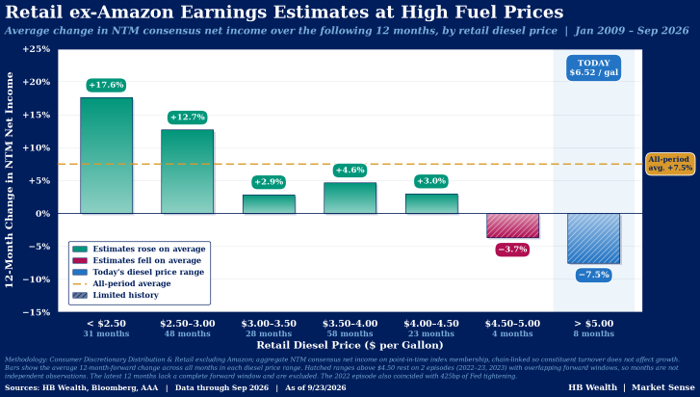
Discretionary, Staples and Transports Estimates Take a Haircut
More than half of S&P 500 industries have faced cuts to 3Q earnings growth expectations since the beginning of July, as higher interest rates, waning tax refund support, and rising fuel prices all start to take their toll on the outlook for consumer and industrial companies. Gas and diesel prices hit a near term bottom in the first week of July and since then a clear pattern of EPS estimates cuts for discretionary, staples and transports companies has emerged. Over the past 12 weeks, three large-cap materials industries – containers & packaging, chemicals and construction materials – have faced the largest cuts to 3Q earnings among S&P 500 companies, though each is being trimmed from an extraordinarily high base and are still largely projected for rather strong EPS growth. Following those, consumer durables & apparel, household & personal products, staples distribution & retail, and food, beverages & tobacco – each from either consumer discretionary or consumer staples – have also been trimmed. Likewise, excluding Amazon (which makes up more than 74% of the industry’s market cap), discretionary distribution & retail estimates fell 190 bps.
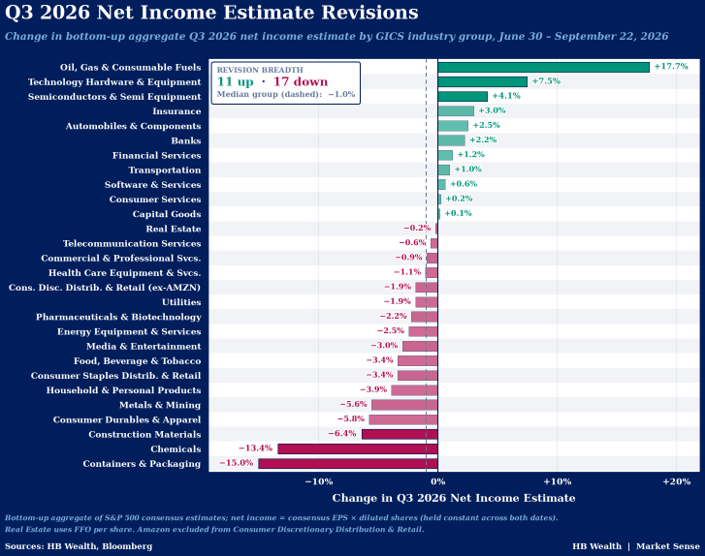
Likewise, while the exact timeline of cuts doesn’t line up with when diesel and gas prices began climbing, transports stocks have had a rough go of it since. From diesel’s low on July 5th, sub-industries passenger airlines (-16.4%), air freight & logistics (-6.1%) and ground transportation (-5.4%) have struggled. In aggregate, estimates for the transports industry have dropped 260 bps since making a high on July 17th, reflecting pressures from the pump. Interestingly, both air freight and ground transportation companies typically use “fuel surcharges” to offset rising fuel costs, making their estimates drop more a function of possibly softer demand in the face of higher prices than a margin issue.
Retailers are the Most Sensitive to Rising Diesel Prices
Industry price correlations to changes in national average diesel prices likewise offer some insight into what groups might be hit hardest should prices continue to rise. Since 2009, consumer discretionary retail & distribution is the most negatively correlated industry to rolling annual changes in diesel prices. Software & services is next – though that likely reflects changes in the economic cycle as prices usually rise with demand – followed by construction materials, telecom services and household & personal products. In fact, of the seven industries that make up consumer discretionary and staples, all but automobiles & components and food, beverages & tobacco are negatively correlated to changes in diesel. Conversely, oil, gas & consumable fuels, energy equipment & services and metals & mining are the most positively correlated groups.
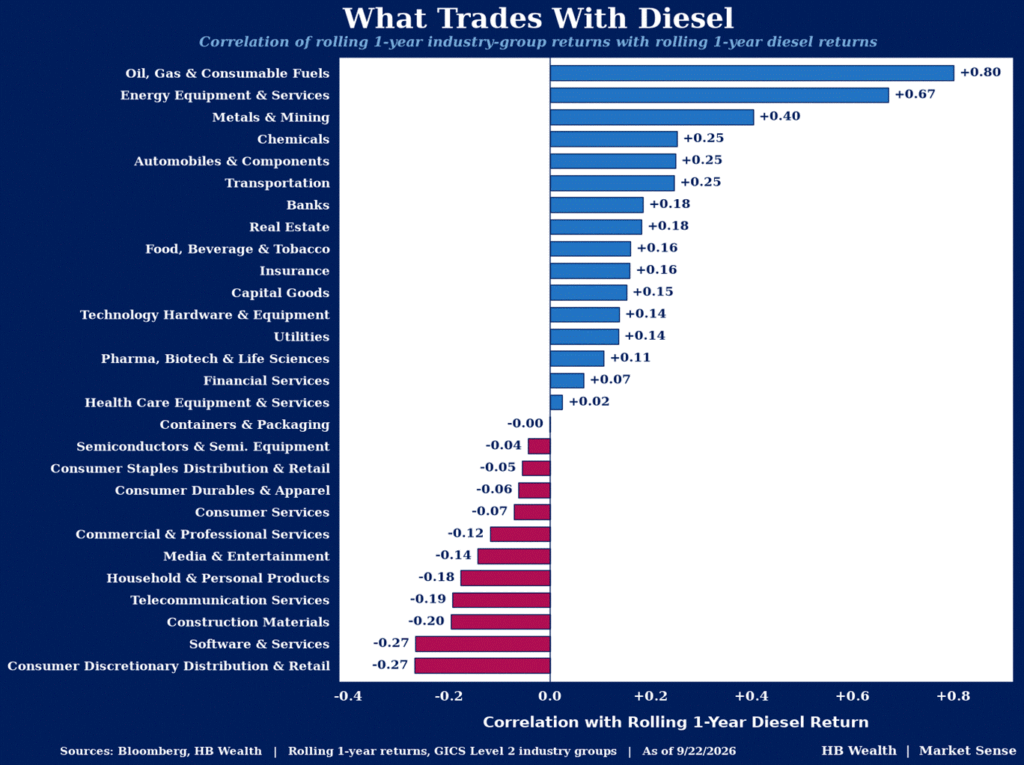
Conversely, oil, gas & consumable fuels, energy equipment & services and metals & mining are the most positively correlated groups. These segments’ earnings outlook will likely continue to improve if higher prices remain.
Weakening Sentiment Holds Back Consumer Stocks
In part due to rising fuel costs, University of Michigan Consumer sentiment has fallen to new all-time lows this year, and this is weighing on consumer stocks of late. Since the sentiment gauge began tumbling at the end of 2024, discretionary excluding Amazon and Tesla has shaved more than 2.1 turns off its forward P/E while staples’ multiple is roughly flat (up 0.2 turns). Though high income sentiment has also fallen to all-time low levels this year, sentiment for the top third minus the bottom third is just a hair below the long-term average but has spiked since May 2025 indicating that consumption continues to be held up by the rich. Thus, retailers that cater to lower- and middle-class consumers face the greatest strains. Unless gas price pressures ease and sentiment recovers, groups like staples distribution & retail – which contains Walmart, Costco, Target and the dollar stores – and specialty retail that cater to low and middle income consumers could continue to face pressure.
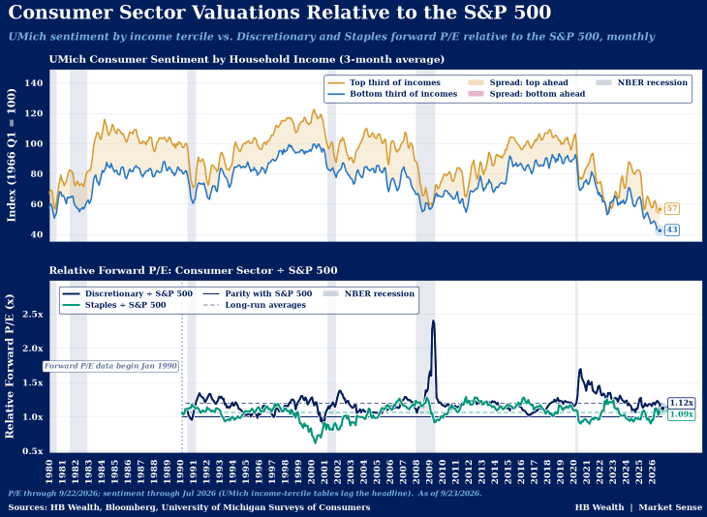
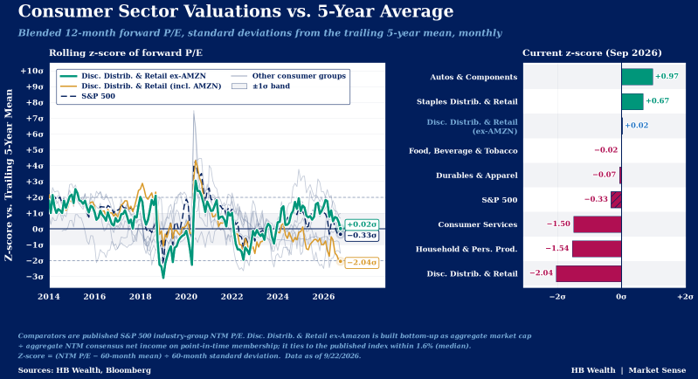
Of the seven consumer industries, only autos & components and staples retail trade north of recent 5-year average forward P/Es – demonstrating the washout in consumer stocks that’s already occurred. Discretionary distribution & retail (2 standard deviations below) is the cheapest consumer group, followed by household products, and consumer services. Overall, more than 61% of discretionary and 74% of staples stocks trade at a discount to recent 5-year average forward P/E.
Valuations could easily be pushed to 2022’s absolute lows for both sectors given the confluence of near-low sentiment and surging prices at the pump. In 2022, diesel surged roughly 63% by June following the onset of the war in Ukraine while consumer sentiment made what was at the time a new low at 50. At that point, discretionary excluding Amazon and Tesla traded at just 14.4x and staples at 20.1x versus 16.9x and 21.1x today. While earnings expectations back then were similar to current consensus forecasts for the next four quarters, discretionary ex-Amazon and Tesla paced roughly 6% growth on average from 3Q22-2Q23 versus forecasts for 4% from 3Q26-2Q27. Thus, if estimates continue to deteriorate, multiples could converge with 2022 lows.
Disclosure: HB Wealth is an SEC‑registered investment adviser. The information reflects the author’s views, opinions, and analyses as the publication date. The information is provided for informational purposes only and does not constitute an offer to sell or a solicitation of an offer to buy any investment product. This information contains forward-looking statements, predictions, and forecasts (“forward-looking statements”) concerning the belief and opinions in respect to the future. Forward-looking statements involve risks and uncertainties, and undue reliance should not be placed on them. There can be no assurance that forward-looking statements will prove to be accurate, and actual results and future events could differ materially from those anticipated in such statements. The information does not represent legal, tax, accounting, or investment advice; recipients should consult their respective advisors regarding such matters. Certain information herein is based on third-party sources believed to be reliable, but which have not been independently verified. Past performance is not a guarantee or indicator of future results; inherent in any investment is the risk of loss.