








Abstract:
- After an extraordinary gain in 2025, silver has struggled in 2026. With last year’s irrational exuberance now largely evaporated, the metal may uniquely benefit from its dual identity as both a precious and industrial commodity.
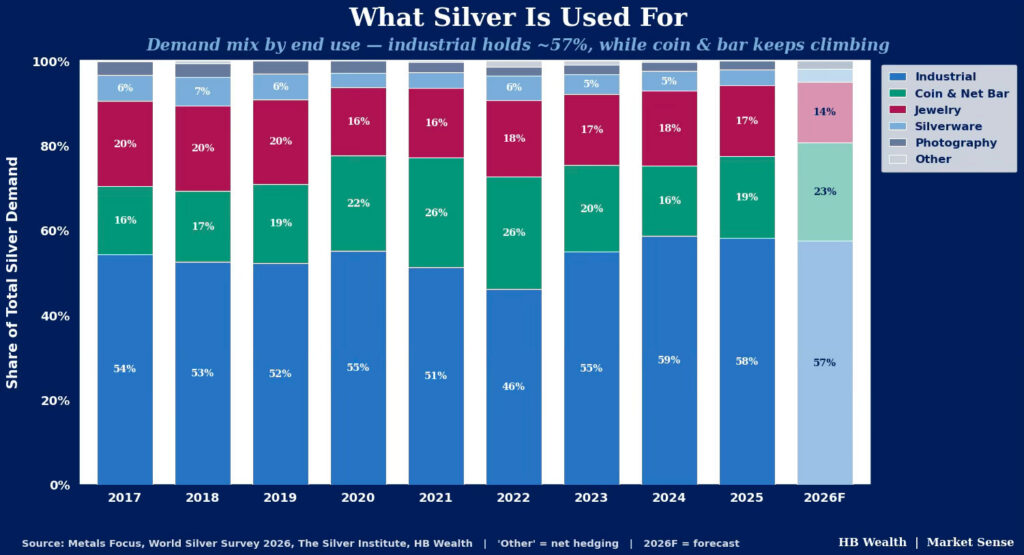
- Silver has long been grouped with gold due to its status as a precious metal with monetary characteristics. However, silver differs from gold in that roughly 57% of forecasted 2026 demand comes from industrial applications.
- Silver’s correlation with copper is currently elevated and sits above its long-term average, but this does not imply that silver has decoupled from gold: silver retains a strong structural relationship with gold, but it is also an industrial input. The recent increase in correlation between silver and copper suggests that industrial and supply-side factors have become increasingly relevant to the price of silver.
- As renewed concerns around persistent inflation, structural deficits and de-dollarization policies appeal to the precious metals side of silver’s dual identity, accelerating industrial production via the AI-capex boom also supports demand for the metal, putting silver at the center of both structural and cyclical trends. This sets a positive backdrop for the price.
- However, silver’s dual identity is also a source of volatility, suggesting the price path is subject to extremes. When precious metals’ investment positioning unwinds, silver’s smaller and less liquid market can amplify the downside, causing it to significantly underperform gold. Meanwhile, silver’s large industrial demand base exposes it to any shortfall in economic growth.
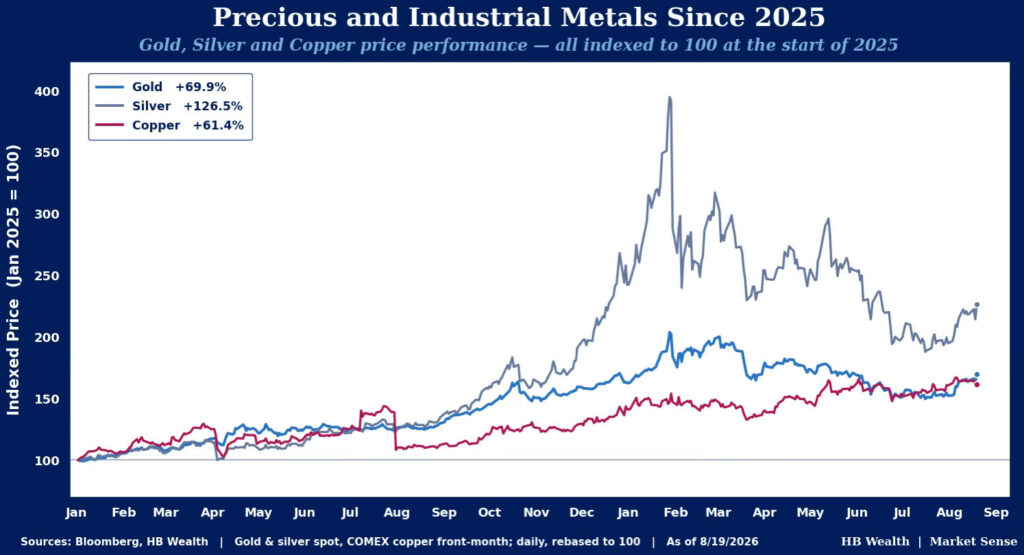
The price of silver has seen significant growth since 2025, meaningfully outperforming gold and copper and reaching an all-time high of $121.65 per ounce on January 29, 2026. The rally began more as an investment story rather than an industrial demand story. Industrial demand provided a tailwind, but the acceleration in silver prices was driven primarily by investment demand, tightening physical markets and subsequently increasing speculative participation.
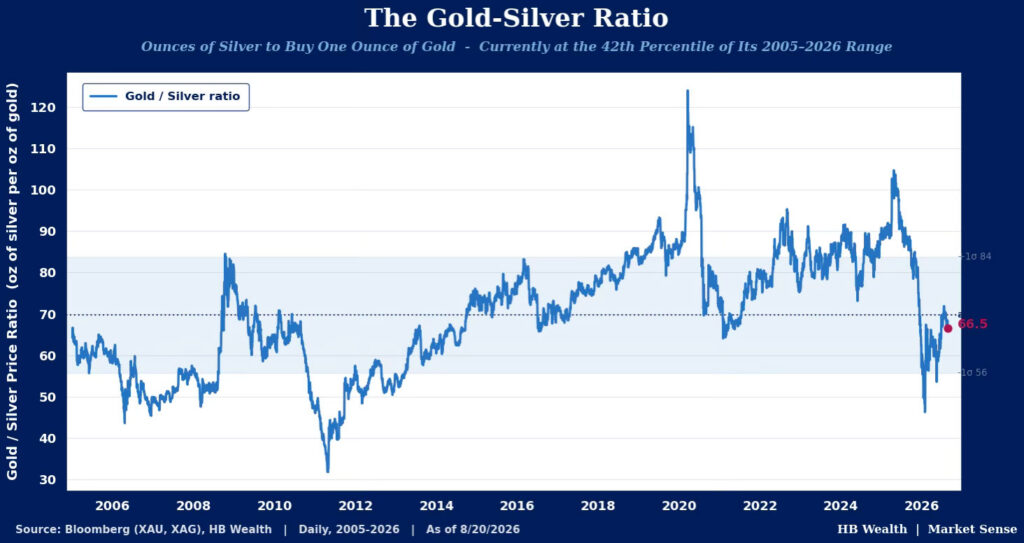
The gold-to-silver ratio is a common ratio used to assess silver’s relative valuation to gold. The ratio fell below 50x in January 2026, its lowest level since the 2011 silver rally, as the gains in silver outpaced gold by a wide margin. The ratio has since reverted toward its longer-term average with the current price of silver down more than 40% from January’s peak. The subsequent correction reflected a sharp reversal in the investment and speculative forces leading the rally. As silver became increasingly extended, a shift towards higher treasury yields and a stronger dollar created headwinds while elevated speculative positioning left the market vulnerable to profit-taking and forced liquidation. The market for silver is relatively small and less liquid than gold, resulting in a larger drawdown. It’s worth noting that this drawdown occurred despite the continuation of supply deficits, suggesting this drawdown was driven more by a normalization of positioning and valuation than a deterioration of underlying drivers of investment demand.
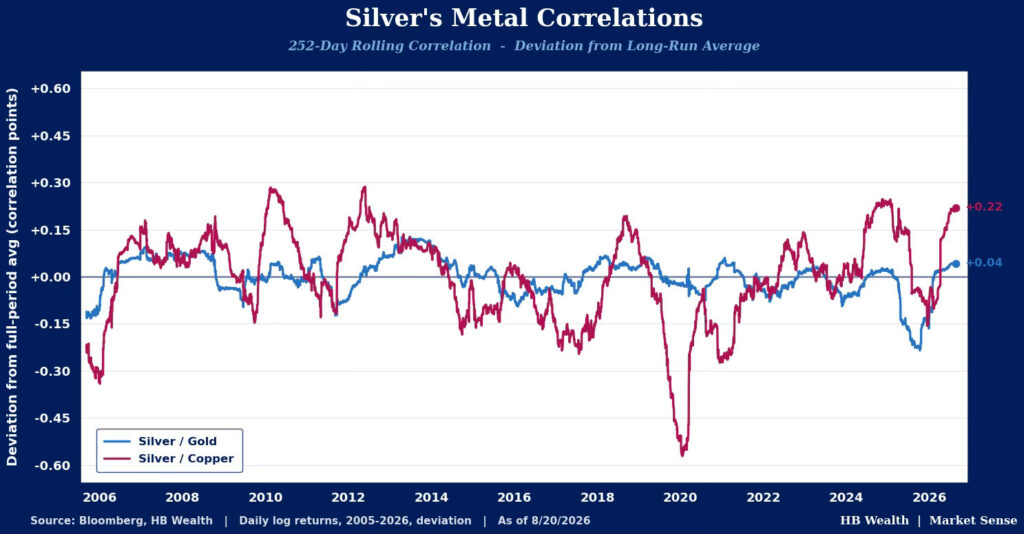
Industrial characteristics have also become increasingly important to price formation for silver. While the metal’s relationship with gold remains firmly intact – the 252-day rolling correlation between silver and gold correlation is 0.04 points above its long-term average – the correlation between silver and copper currently stands approximately 0.22 points above its long-term average. This suggests that silver has developed a stronger sensitivity to industrial and cyclical factors without fundamentally decoupling from its precious-metal characteristics.
Supply and Demand Dynamics
The silver market has recorded a deficit in each of the past five years, with demand exceeding supply. The Silver Institute expects the market to remain in a deficit for a sixth consecutive year in 2026. Silver occupies a unique position in the commodities market, as it combines the characteristics of both a precious metal and an industrial commodity. Silver’s physical properties, including its high electrical and thermal conductivity, make it an import input across varies industrial applications, such as electronics, solar photovoltaics, and automotive components. At the same time, silver retains monetary and investment characteristics like gold, with demand coming from jewelry, bars and coins, as well as investment products. This dual role makes silver’s demand sensitive to economic activity and market sentiment, leading to a fundamentally different demand profile than other metals.
Silver’s supply profile is also distinctive. While silver is produced through both mining and recycling, most newly mined silver is produced as a byproduct of other metals, primarily lead/zinc, copper, and gold. As a result, production is influenced not only by the economics of silver mining, but also by the demand for other metals. This dynamic makes silver supply less responsive to changes in the price of silver and instead is often driven by the underlying economics and production levels of the primary metals being mined. This supply structure has contributed to a persistent imbalance between global silver supply and demand.
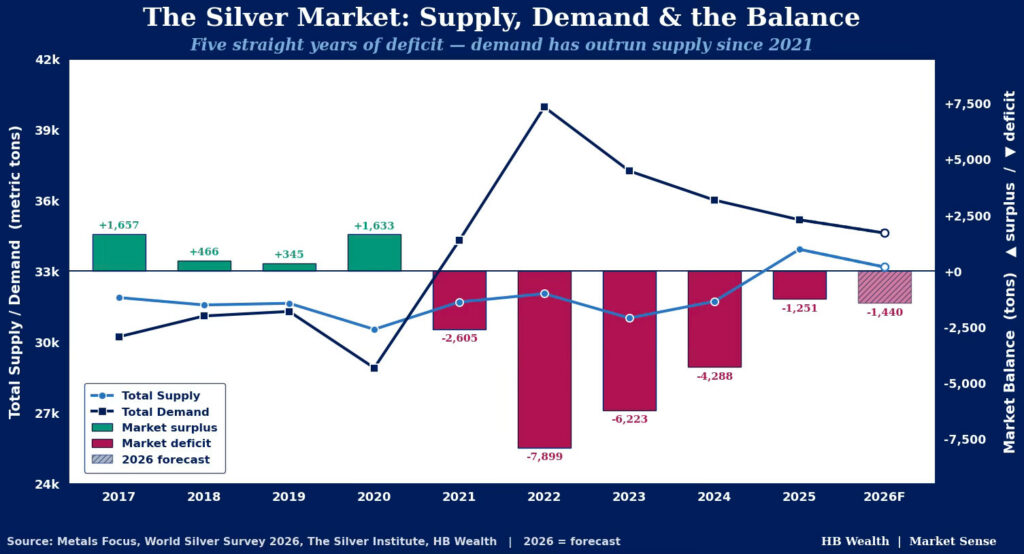
While silver’s hybrid identity is a source of strength, it is also a source of volatility. Thus, while the dynamics of supply and demand are constructive for silver at the moment, the metal’s price path will almost certainly be lumpy. Macro conditions influence silver through its relationship with gold, with lower real yields and a weaker dollar generally supportive of precious metals, while persistent physical-market tightness provides an additional source of support. Conversely, when real yields and the dollar rise and investment positioning unwinds, silver’s smaller and less liquid market can amplify the downside, causing it to significantly underperform gold. At the same time, silver’s large industrial demand base exposes it to economic growth and trends in electrification, electronics and other industrial applications. When precious metal, industrial and physical-market forces align, silver can significantly outperform both gold and copper, but reversals can likewise be punishing.
Disclosure: HB Wealth is an SEC registered investment adviser. The information reflects the author’s views, opinions, and analyses as the publication date. The information is provided for informational purposes only and does not constitute an offer to sell or a solicitation of an offer to buy any investment product. This information contains forward-looking statements, predictions, and forecasts (“forward-looking statements”) concerning the belief and opinions in respect to the future. Forward-looking statements involve risks and uncertainties, and undue reliance should not be placed on them. There can be no assurance that forward-looking statements will prove to be accurate, and actual results and future events could differ materially from those anticipated in such statements. The information does not represent legal, tax, accounting, or investment advice; recipients should consult their respective advisors regarding such matters. Certain information herein is based on third-party sources believed to be reliable, but which have not been independently verified. Investments in commodities and precious metals, including silver, involve risks and may experience significant price volatility. Investors should consider their individual objectives, risk tolerance, and financial circumstances before making any investment decision.