








Abstract:
- The annual Jackson Hole Symposium is August 27-29 and will be the first under the new Chair, Kevin Warsh. Market participants should not treat it as a forward-guidance event as was common during previous regimes.
- The Jackson Hole Symposium will nonetheless offer the new Fed Chair the chance to lay out the Fed’s future. We are looking for commentary on the reaction function, the energy shock, the task forces, and composition of the balance sheet. The latter issue is particularly relevant given recent Treasury action to dampen rising long yields.
- While the range of possibilities is theoretically endless, we do see three most likely potential scenarios emerging for Fed policy. In the order of least to most likely, in our view:
- The Chair may spend his time trying to regain credibility by emphasizing that the Fed won’t allow persistently high inflation. This could reprice September rate hike odds higher, leading to a bear flattening.
- The two-sided mandate may be the focus, parsing labor data alongside the inflation objective, and may lead to renewed steepening.
- Or, there may be no real macro content and a complete focus on institutional reform, speaking to the official conference theme. While the market may take this as a dovish omission, it would be with low conviction and offers minimal change for bond pricing.
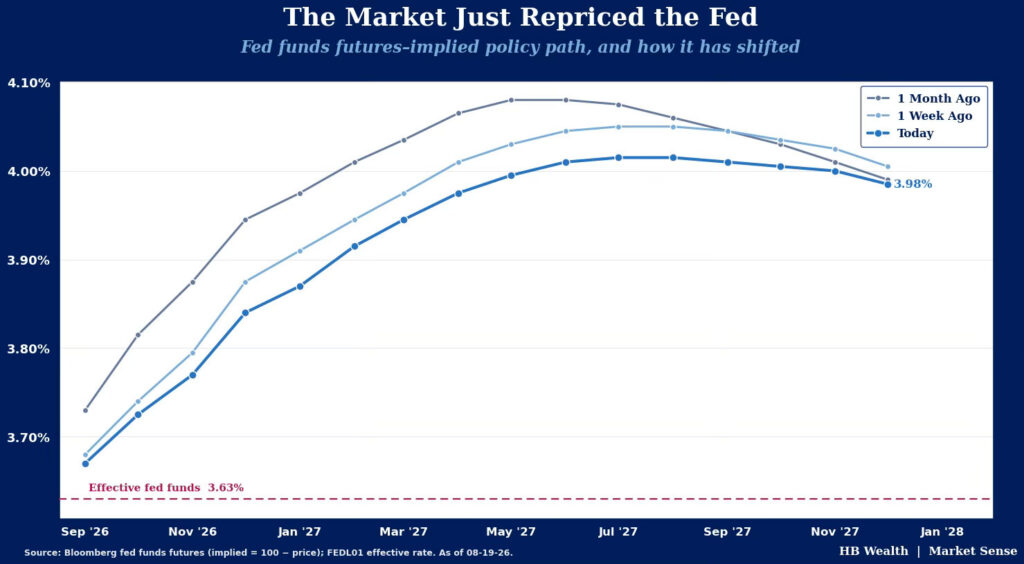
- The most binary outcome sits at the front end where a hike by October is roughly a coin toss and cuts are unpriced. The long end doesn’t really express a Fed view directly since at 5.2%+, the 30-yr is pricing term premium and credibility, and is subject to spells from the Treasury Secretary.
The theme of this year’s Jackson Hole symposium, “Financial Innovation: Implications for Payments and Policy”, points to topics like payment rails, tokenization, and digital settlement, rather than an economically focused conference. This implies any macro content is likely to be in Warsh’s opening remarks, and brief at best. Yet, Warsh spent his first two meetings purposefully undoing the signaling channel by removing forward guidance from the post-meeting statement and shortening the statement overall considerably. He argues that the Fed should spend less time telling the market what it will do and more time defining the conditions under which it would act. Thus, immediately actionable content should not be expected. The Jackson Hole Symposium will nonetheless be the first venue with the capacity for the new Fed Chair to start laying out what the new reaction function could actually look like. In that vein, we will be looking for a few things:
- Any color on the reaction function: Any description of conditions that would trigger Fed action, be it headline inflation, core, expectations, etc. A focus on expectations would give more room to look through oil impacts.
- Considerations of the energy shock: Treating it as a threat leading to bigger inflation could argue for a September cut.
- Preview of task force output: It is too soon to expect much from the five task forces, but scope and timeline would be a start.
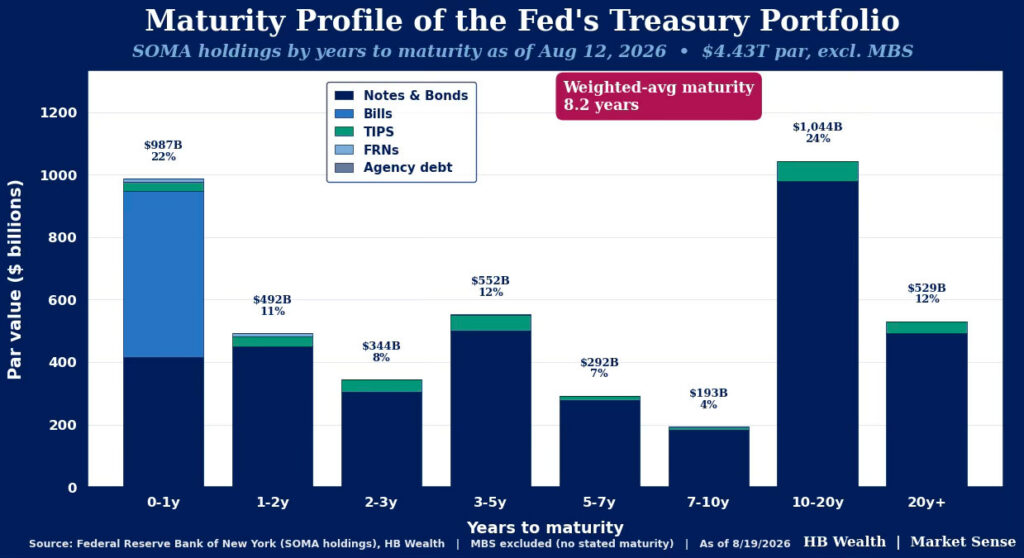
- Balance sheet composition: With all MBS principal being recycled into Bills at a pace of ~$20B/mo, the Fed is effectively shortening its balance sheet. That rebuilding of short-term paper relative to long provides capacity for a maturity-swap operation if needed to put a ceiling on the long end. While something like an operation twist 2.0 is not expected to come out of Jackson Hole, we are watching for continued capacity to facilitate such a program, particularly if Treasury actions this week fall short of soothing bonds nerves for long.
While the range of possibilities is theoretically endless, we do see three most likely scenarios emerging for Fed policy from the Jackson Hole Symposium:
Our first low probability possibility is the Chair spends his time trying to regain credibility, with an emphasis that the Fed won’t allow persistently high inflation. This method was interpreted by markets as a losing strategy at the last Fed meeting, and thus we give it a mere 20% probability as the headline from Jackson Hole. Nonetheless, if the path proves successful on another attempt, it could reprice September rate hike chances higher, causing the front end to sell off while the long end takes some comfort from inflation-fighting credibility, leading to a bear flattening.
A second, nearly equally low probability focus could be a returned focus to the two-sided mandate, where labor data is more directly called out alongside the inflation objective. Given the still-low unemployment rate but material weakening in jobs data recently, a read through from jobs is extremely opaque. Nonetheless, presuming employment and wage growth is the focus, this might dampen September hike expectations while the long end stays elevated due to inflation-driven term premium, leading to a renewed steepening. We assign a 20% probability of this outcome as well.
Lastly is a complete focus on institutional reform, speaking to the given theme and Fed governance but no real macro content. That scenario is underappreciated but perhaps most plausible given the agenda and would likely be taken as dovish by omission by the market, but with low conviction. This scenario offers minimal change for bond pricing and is the most benign outcome, in our view, while also the most likely. We give this a 60% probability.
The most binary outcome sits at the front end of the curve where a hike is roughly a coin toss and cuts are unpriced. The long end doesn’t really express Fed view directly since at 5.2%+, the 30-yr is pricing term premium and credibility rather than fed funds path and is now clearly trading under the spell of the Treasury Secretary. The safer place in the immediate term is to focus on carry and rolldown in the belly of the curve.
Disclosure: HB Wealth is an SEC registered investment adviser. The information reflects the author’s views, opinions, and analyses as the publication date. The information is provided for informational purposes only and does not constitute an offer to sell or a solicitation of an offer to buy any investment product. This information contains forward-looking statements, predictions, and forecasts (“forward-looking statements”) concerning the belief and opinions in respect to the future. Forward-looking statements involve risks and uncertainties, and undue reliance should not be placed on them. There can be no assurance that forward-looking statements will prove to be accurate, and actual results and future events could differ materially from those anticipated in such statements. The information does not represent legal, tax, accounting, or investment advice; recipients should consult their respective advisors regarding such matters. Certain information herein is based on third-party sources believed to be reliable, but which have not been independently verified.