








Break of Support Increases Chances of a Tough Spring for Stocks

The S&P 500 has broken through key support at its 100-day and 20-week moving average for the first time in about a year, increasing the probability of a full correction in the index in coming weeks.  There have been just 8 other instances when the market has broken down as much through the key level after a bullish advance in the last ten years.  The market carried on to deeper lows in 6 of the 8 instances.  The range of declines from pre-breakdown peak to ultimate low was 0% (in 2016/late 2020) to 22.5% (in 2022). On average, the declines lasted 19 weeks from pre-breakdown peak to ultimate trough, though the range is wide.  The market managed to shrug off the break of the 20-week moving average in 2016 and late 2020.
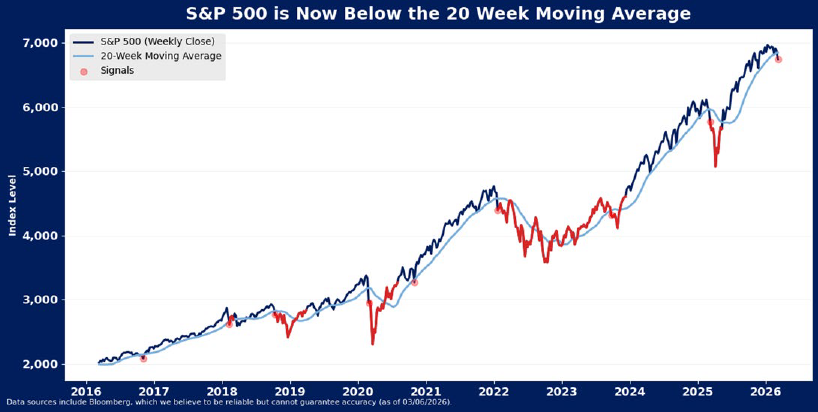
Line chart showing the S&P 500 index from 2016 to 2026. The chart highlights when the S&P 500 falls below its 20-week moving average, marking these periods in red. The overall trend is upward with fluctuations.

A resolution of war with Iran and/or cooldown in the price surge for oil is the primary, but not the only indicator to watch for stocks. VIX has spiked but is not yet at 40 – the level that normally suggests a sentiment low is likely to emerge.  Momentum (14-day RSI) may also need to drop to near 30 to suggest a low is near. Valuations are still above levels supported by macro data and will likely need to fall closer to our model’s indication of 19X before a buying opportunity emerges.  Policy shifts also often create sentiment shifts.  The FOMC is scheduled to meet again next week.  Higher oil prices complicate matters, but if the Fed telegraphs greater chances of an ease coming due to jobs weakness, it could also help stocks find their footing.


Disclosure: HB Wealth is an SEC-registered investment adviser. The information reflects the author’s views, opinions, and analyses as the publication date. The information is provided for informational purposes only and does not constitute an offer to sell or a solicitation of an offer to buy any investment product. This information contains forward-looking statements, predictions, and forecasts (“forward-looking statements”) concerning the belief and opinions in respect to the future. Forward-looking statements involve risks and uncertainties, and undue reliance should not be placed on them. There can be no assurance that forward-looking statements will prove to be accurate, and actual results and future events could differ materially from those anticipated in such statements. The information does not represent legal, tax, accounting, or investment advice; recipients should consult their respective advisors regarding such matters. Certain information herein is based on third-party sources believed to be reliable, but which have not been independently verified. Past performance is not a guarantee or indicator of future results; inherent in any investment is the risk of loss.

A woman with long brown hair wearing a blue blazer and a necklace smiles at the camera. The background is softly blurred with light and blue tones.

Gina Martin Adams, CFA, CMT

Chief Market Strategist, Shareholder

Gina Martin Adams, CFA, CMT, is the Chief Market Strategist for HB Wealth. With more than 25 years of experience at leading global financial institutions, Adams brings deep expertise in market analysis, thematic research, and translating complex economic trends into actionable strategies. She collaborates with HB Wealth’s investment team to deliver timely market perspectives, share actionable insights, and enhance the firm’s visibility as a leading voice in the industry. She contributes to advancing proprietary research, supporting the development of new investment products, and enhancing the client experience through thought leadership and education. She pursues a top-down perspective and model-based approach, leveraging fundamental, technical, and quantitative perspectives to inform investment decisions, and frequently presents her views in the media and at industry conferences, professional associations and investment organizations.

A young man with short brown hair, wearing a dark suit, white shirt, and blue tie, stands in front of a blurred background with lights and blue tones.

Matthew Sanders

Senior Investment Research Analyst

Related Insights & News

A Deep Dive: Will 2026’s Unicorns Pierce the Market’s Armor or Prove to Be Trusty Steeds?

Abstract:2026 could be the best year for IPOs on record based on already completed deals…

Read More

Emerging Markets are Outperforming and Getting Cheaper at the Same Time

Emerging Market equities are on pace for a second consecutive year of outperforming U.S. stocks,…

Read More

A Deep Dive: Magnificent-Seven’s Breakup Continues Amid Capex Boom

Abstract:The Magnificent Seven has managed to recover its year-to-date loss with April’s rally, though most…

Read More

A Deep Dive: New Fed Chair May Create New Regime for Financial Markets

Abstract: Monetary Policy Faces Three Big Changes with New Fed Chair With a new Chair…

Read More

The above is not a recommendation to purchase or sell a particular security and is not legal, investment or tax advice. Results are not guaranteed. All investing involves risk.

Past performance is not a guarantee of future results for any investment. Private alternative investments are not for every client. An individual must be qualified to invest in a private investment based on their net worth and/or other criteria, and they may qualify to invest in some alternative investments while not being allowed to invest in other alternative investments. Alternative investments are not risk-free and there is no guarantee of achieving attractive performance compared to similar liquid investments. Risks associated with investments in private alternatives include the illiquid nature of such investments, risks associated with leveraged investments, manager-specific risks, sector-specific risks, and in certain cases geographical risk, as well as the risk of loss of principal.