








Abstract:
- The third year of the U.S. Presidential cycle is normally the strongest of the four years for stocks, and the outcome of the midterms alone is unlikely to dampen the view. Economic conditions, earnings trends and monetary policy should still matter more than the party mix in Washington.
- As gas prices rise, so do the odds of a Democratic sweep in Congress. Polymarket traders now assign an 87% chance that Democrats take the house and more than 50% probability they take the Senate.
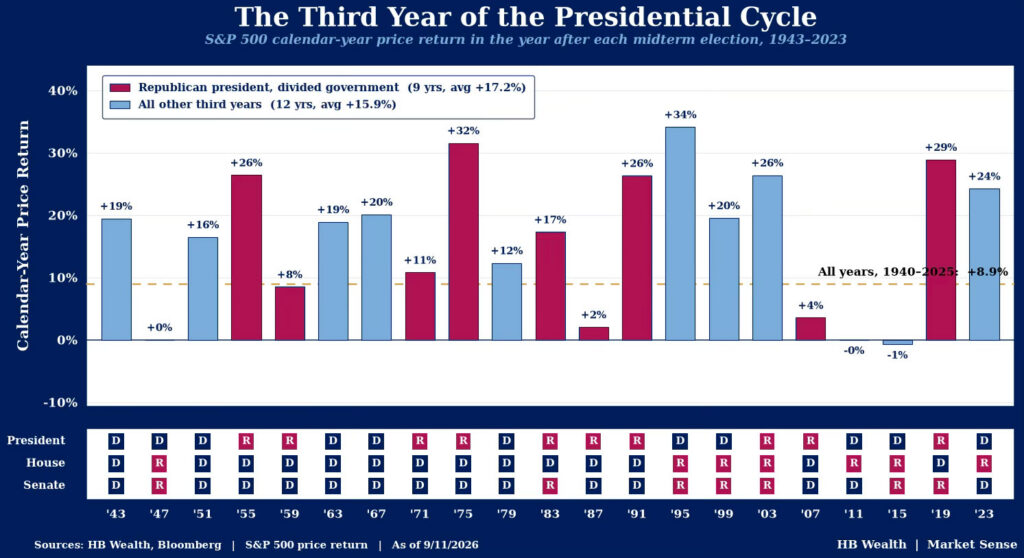
- However, the average third-year market return under a Republican President with a Mixed or Democratic Congress was 17.3%, so a party change is not likely something to be feared by stocks.
- Much may depend on how rapidly war in the Middle East resolves, the extent to which the Fed hikes rates, and how earnings growth evolves in the short run. We are watching inflation’s impact on real wages and public pushback on data centers as two critical issues this election season. The rising cost of, and level of, public debt may also continue to make waves.
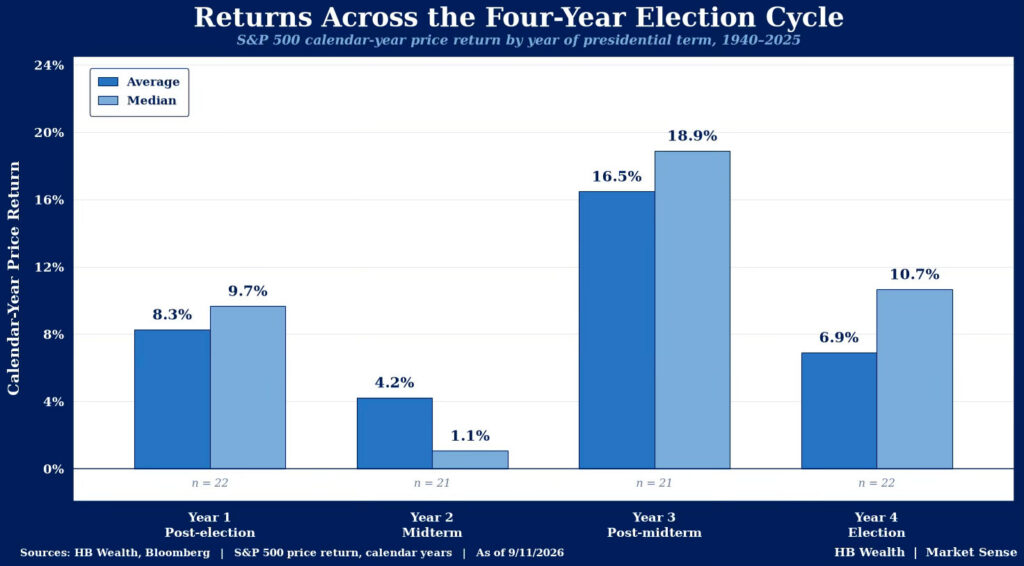
Presidential Election Cycle Theory generally supports the outlook for stocks next year. According to the theory, created by Yale Hirsch, inventor of the Stock Trader’s Almanac, stocks follow a four-year pattern. On average, the year after midterms (the third year of a Presidential term) is the strongest of the 4-year election cycle years. Stocks returned nearly 14% in the third year of Presidential cycles since 1931, on average, well north of the average gain of just over 6% in the other three years of Presidents’ terms.
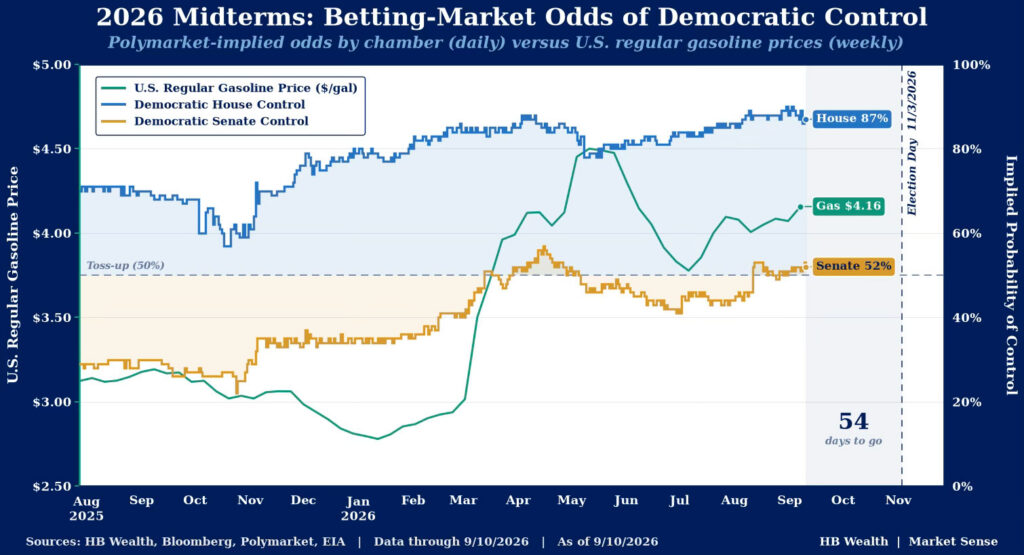
Retail gas prices are rising, and while that may alter the prospects for the party mix in Congress after the midterms, this fact alone should not materially change the outlook for stocks.
The war in Iran is once again pressuring U.S. average retail gas prices above $4.00, and on average over the last six months, gas prices are up 29% compared to the same period a year ago. As gas prices rise, Polymarket trades are reflecting the diminishing prospects for Republicans to retain Congressional control in the upcoming elections. Odds of a democratic sweep in the midterms have just crossed 50%, with an 87% chance for the party to take control of the House and just over 50% chance of a Senate sweep. This is the highest probability of a Democratic sweep since April, according to Polymarket bets. Back then, average US retail gasoline prices touched $4.50.
Elections are just one of the multitude of factors that drive stocks at any given time, and history suggests the outlook for equities should not change much if current odds prove correct. Since 1940, the average market return in the third year of the election cycle has been 16.5%. Under Republican Presidents, the average is 18.2% and under Democrats, the average is 14.9%. However, Republican Presidents with a Mixed Congress (2 instances) presided over an average 23.1% return in the year after midterms, while Republican Presidents with a Democratic Congress (7 instances) saw a 15.6% market return.
Given this evidence, a party change in Congress seems highly unlikely to materially alter the path for stocks, and the election is only likely to pressure stocks if it also results in or coincides with a material change to the outlook for the foundation of stock prices’ gains – earnings and economic conditions. On that front, there are several key issues to watch this election season, including issues currently top of mind for the market such as how rapidly war in the Middle East resolves and the extent to which the Fed hikes rates starting as early as this week. Additionally, we are closely watching inflation’s impact on real wages and public pushback on data centers as two critical issues this election season. The rising cost of, and level of, public debt may also remain a key issue in the weeks leading up to November’s election.
Key Issue #1: The Consumer Struggle with Inflation
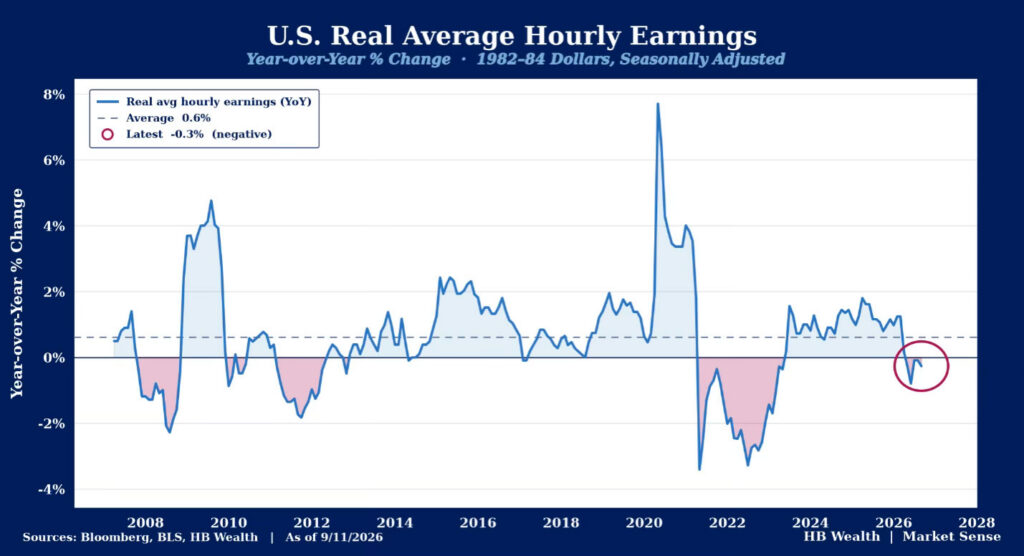
Consumers are voters, and consumers are extremely unhappy at this time, shown by the University of Michigan’s consumer sentiment index near an all-time low. This implies a very high likelihood of another party change in Washington, and may present a risk to the economy and earnings outlook. Tax reform and a stabilizing job market combined to support a slightly stronger consumer backdrop in the first half of this year, allowing consumers to power through the first surge in oil prices related to the war in Iran. However, tax refunds have largely been spent, leaving consumers more reliant on wages to fuel spending. Wages aren’t keeping up with inflation – for the first time since 2022, real wage growth is falling, and this could be trouble for consumer spending in the final months of 2026. Consumer stocks are an increasingly smaller part of the equity market but still a big share of overall GDP. A loss of support from the consumer will leave the economy even more reliant on a single source of growth – AI spending.
Key Issue #2: Data Center Construction
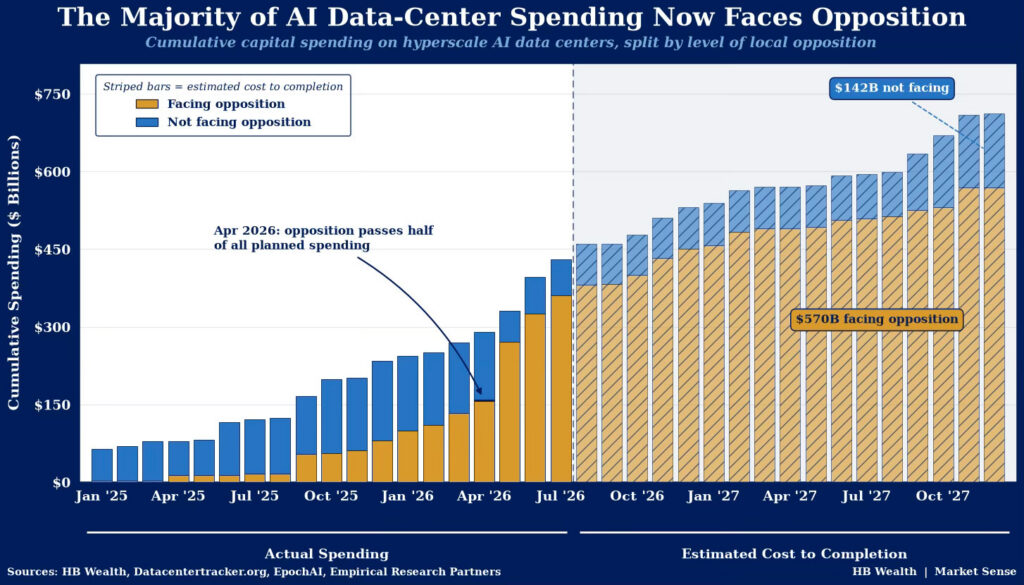
That leads to a second key risk to watch this election season – data center construction. Public pushback on data centers may reach a fever pitch with the midterms and if it results in a slower pace of AI-spending, may present a downside risk to the economic and earnings outlook as markets look into 2027. AI-company investment has been an extraordinary support to economic growth – it drove nearly half of U.S. GDP growth in four of the last five quarters. Microsoft, Alphabet, Amazon, Meta, Oracle, and CoreWeave combined are now expected to spend well over $800 billion dollars in 2026 and $1 trillion+ for each of the next four years. However, this growth comes at an environmental cost that is increasingly worrisome for communities, and public pushback has been on the rise. A year ago, well under half of data center spending faced public opposition. Currently, 80% of spending is facing public pushback. Given the fact that investment is a predominant driver of economic growth, this pushback alone may slow the pace of earnings and economic growth. Any policy-imposed construction slowdown may further complicate the outlook.
Key Issue #3: Federal Debt and Deficits
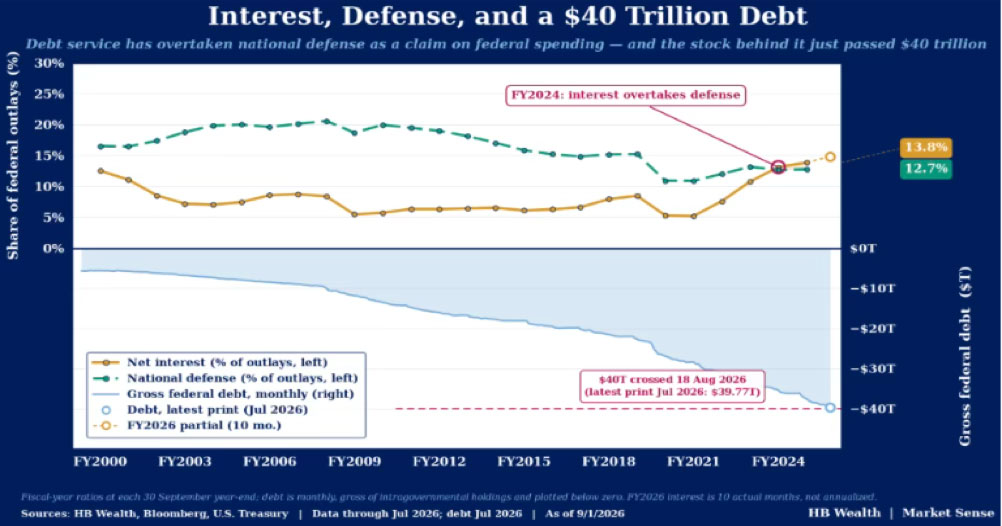
Finally, gross national debt reached a new high of more than $40 trillion in August, and driven by higher borrowing costs and the rising deficit, annual net interest payments on the debt have grown so rapidly that they recently exceeded national defense spending for the first time since World War II. Recent surveys show that a majority of Americans now see the deficit as a top priority for Congress and the President. Resonate (AI-Powered Consumer Data Insights) found last year that 78% of Americans want the deficit to be a top priority, and in key swing states, 90% of voters demand a clear debt-reduction plan. This sentiment spans across political lines, with Republicans, independents, and even many Democrats viewing unchecked spending as a threat to economic stability. Yet, the debt and deficit situation is only worsening, even after the longest government shutdown in history and severe cutbacks via the Department of Government Efficiency (DOGE) last year. Along with persistent inflation and issuance of artificial intelligence (AI) debt, the ballooning debt and deficit may continue to pressure bond yields, increasing the cost of capital for businesses, constraining household demand for debt-funded purchases, and elevating focus on policymakers while infusing volatility into financial markets.
Disclosure: HB Wealth is an SECregistered investment adviser. The information reflects the author’s views, opinions, and analyses as the publication date. The information is provided for informational purposes only and does not constitute an offer to sell or a solicitation of an offer to buy any investment product. This information contains forward-looking statements, predictions, and forecasts (“forward-looking statements”) concerning the belief and opinions in respect to the future. Forward-looking statements involve risks and uncertainties, and undue reliance should not be placed on them. There can be no assurance that forward-looking statements will prove to be accurate, and actual results and future events could differ materially from those anticipated in such statements. The information does not represent legal, tax, accounting, or investment advice; recipients should consult their respective advisors regarding such matters. Certain information herein is based on third-party sources believed to be reliable, but which have not been independently verified. Past performance is not a guarantee or indicator of future results; inherent in any investment is the risk of loss.