








Abstract:
- The yield on the 10-year Treasury bond is above 5% for the first time since late 2007, and it is now extremely oversold, suggesting in the short run that a Fed hike could trigger at least a brief reprieve for bonds.
- Yet, the longer-term drivers of higher yields appear unlikely to fade anytime soon as a strong capital spending cycle and rising commodity prices collide with heavy federal debt loads to reduce the appeal of government debt.
- The 10-year yield alone is not a strong predictor of equity valuations. The last time the 10-year yield neared 5% in 2023, the S&P 500 P/E was 17X, but the 10-year also held around 5% in 2006-7 and 1998-9, and in those periods, forward P/E averaged 14.7X and 22.9X, respectively.
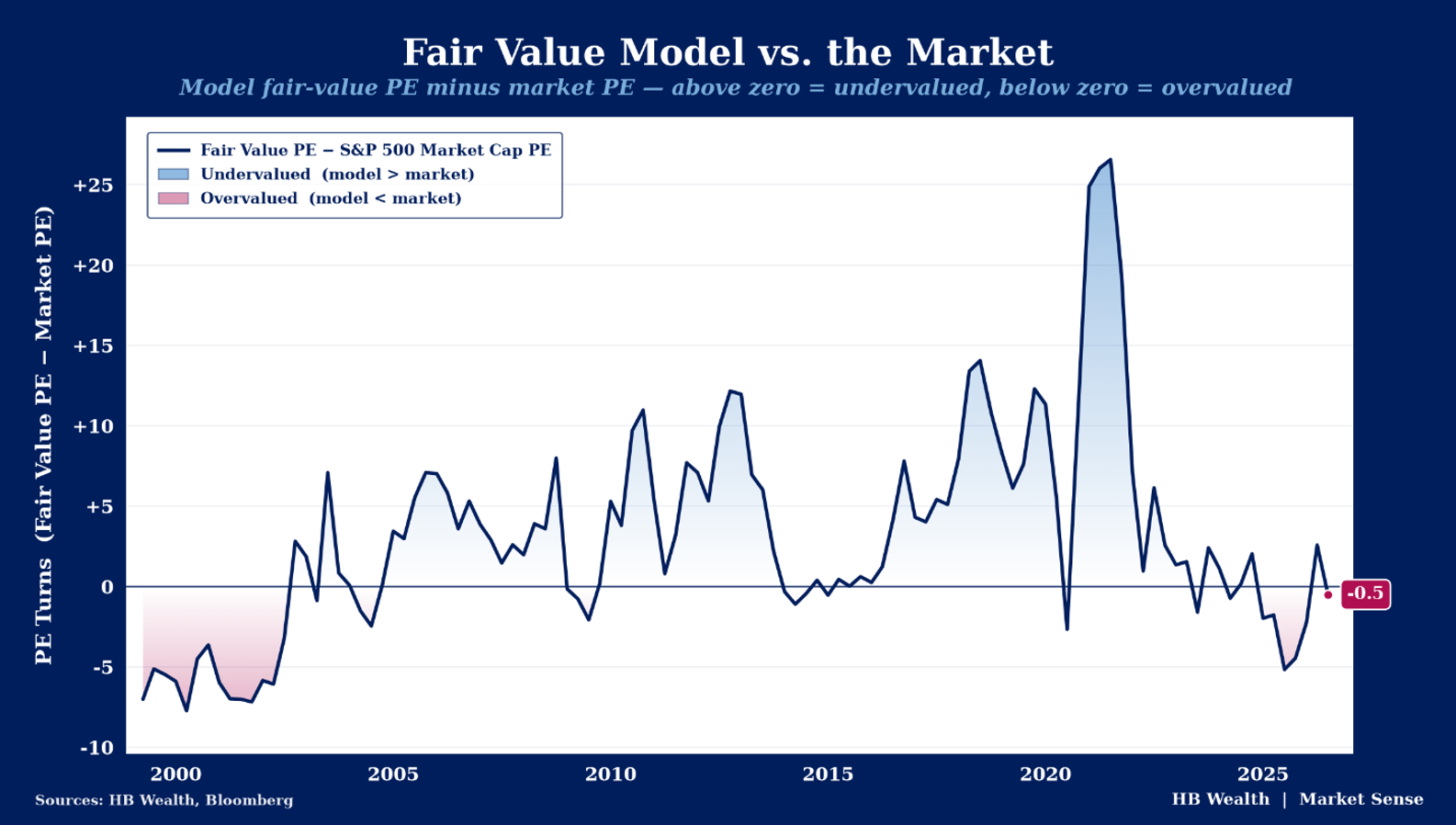
- However, the repricing of the bond market has suppressed equity multiples and may continue to do so. Equity market P/Es have dropped for most of this year and the S&P 500 trading at 19X is now in line with our fair value model.
- Correlations between stocks and yields are signaling a new stocks-bonds regime has emerged post-Covid, and valuations for all S&P 500 industries are somewhat exposed. If rates keep rising, valuations will remain pressured, but stock prices can keep rising as long as earnings are likewise on the rise.
Valuations May Remain in a Downtrend with Interest Rates on the Rise
The yield on the 10-year Treasury bond is above 5% for the first time since late 2007, as a strong capital spending cycle and rising commodity prices collide with heavy federal debt loads to reduce the appeal of government debt. Thanks to the rising 10-year Treasury yield, S&P 500 index forward P/E dropped to just over 19X from its peak of 23.2X in October last year, and trailing P/E has dropped from 28.8X to 26.2X over that time. If recent history is a guide, there may be more downside to come – the last time the 10-year rate was near 5% (in 2023), the market forward multiple was near 17.5X, about 1.5X below current levels and the trailing multiple was 20.8X, about 5.4X below present.
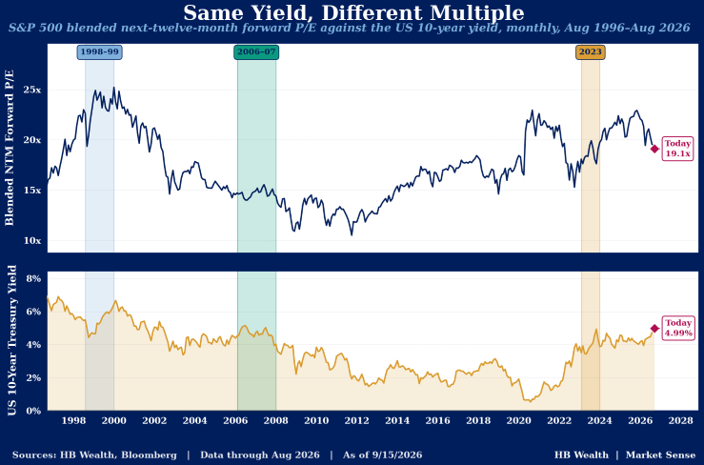
However, rates alone are fairly poor predictors of valuations. The 10-year also held around 5% in 2006-7 and 1998-9, and in those periods, forward P/E averaged 14.7X and 22.9X, respectively. Trailing P/E averaged 16.4X and 24.2X, respectively. Among other things, the direction of travel for rates, the yield curve spread and the trend in earnings growth all help determine valuation multiples, in addition to the absolute level of rates. These factors are all included in our assessment of fair value, which currently suggests multiples are trading right around where they should be. Thanks to compressing valuations for most of this year, our model for the S&P 500 shows equities are now fairly valued, after a period of irrational exuberance took multiples beyond fair value in late 2025.
New Norm, or Back to Norm, for Stocks and Bonds
Some of the recent rise in interest rates may be due to the bond market’s nervousness around Federal Reserve credibility, and thus the pressure on yields may be somewhat relieved if the Fed starts hiking short-term interest rates. But, short-term directional shifts aside, rates appear to be in the midst of a longer-term process of repricing, and the relationship between stocks and bonds is likewise changing to reflect an altered economic landscape.
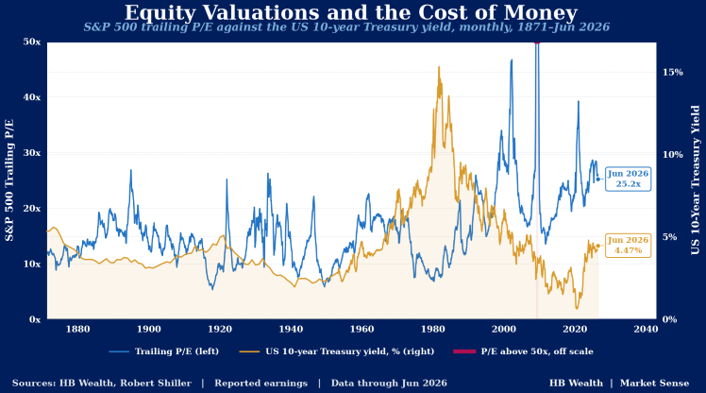
While markets have become accustomed to low interest rates, yields below 5% are not the norm. U.S. 10-year yields were over 5% for three decades from the late 1960s to the late 1990s. On average, the equity market forward multiple was 19.7X in past periods of 10-year yields between 5-6%.
Likewise, a regime shift in the relationship between stocks and bonds occurred around the pandemic, and this regime shift means that as long as yields are rising, the bond market may remain a constraint on stocks. Prior to 2020, in the era that followed the Tech bubble and included the Great Financial Crisis, valuations and interest rates moved together as the predominant macroeconomic risk was a growth scare. Thus, when interest rates rose, so did stock prices.
Valuations are now moving in the opposite direction of interest rates, returning to norms prior to the turn of the century, when the predominant risk was inflation. Over the last five years and especially over the last three, valuation for every industry group within the equity market has shown a negative correlation to yields, to varying degrees.
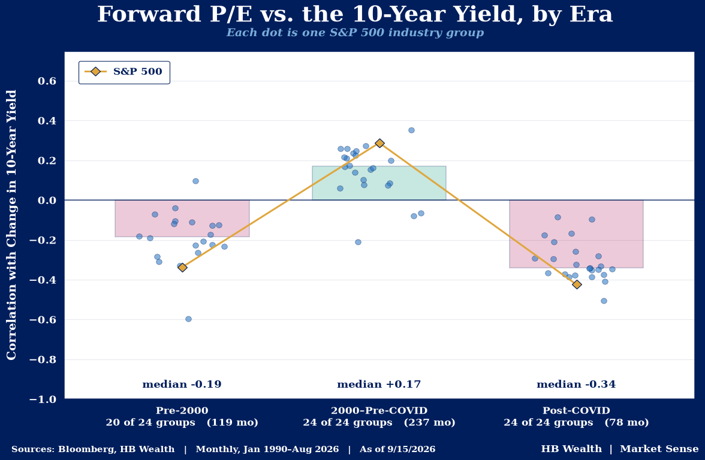
Broadly, this suggests stock price gains may remain held back by rising interest rates, and more dependent on earnings growth. So far, higher interest rates have not meaningfully slowed the pace of earnings growth, and if the consensus is correct, they may not do so anytime soon. AI spending and commodity price gains together remain the dominant drivers of earnings growth with consensus rapidly hiking second half forecasts for the energy and tech sectors. That suggests the real risks to earnings stem from a retreat in commodity prices – though in that scenario, misses in energy could be offset by gains for the consumer-based groups which have been pressured at the pump – or a slowdown in AI-capex. Neither are our current base case, but the extreme upward revisions bear monitoring.
Disclosure: HB Wealth is an SEC-registered investment adviser. The information reflects the author’s views, opinions, and analyses as the publication date. The information is provided for informational purposes only and does not constitute an offer to sell or a solicitation of an offer to buy any investment product. This information contains forward-looking statements, predictions, and forecasts (“forward-looking statements”) concerning the belief and opinions in respect to the future. Forward-looking statements involve risks and uncertainties, and undue reliance should not be placed on them. There can be no assurance that forward-looking statements will prove to be accurate, and actual results and future events could differ materially from those anticipated in such statements. The information does not represent legal, tax, accounting, or investment advice; recipients should consult their respective advisors regarding such matters. Certain information herein is based on third-party sources believed to be reliable, but which have not been independently verified. Past performance is not a guarantee or indicator of future results; inherent in any investment is the risk of loss.