








Abstract:
Hyperscalers’ plans to spend more than $700 billion in 2026 and another $1 trillion in 2027 building AI infrastructure implies inflation risks may remain, even if supply constraints in the Middle East are resolved.
While the financial markets appear to believe inflation is somewhat temporary and due to a supply shock from conflict with Iran, non-energy commodity prices are hitting new all-time highs, thanks in part to the demand shock from tech sector capex. Silver, copper and electricity prices are all surging.
Tech was not the driver of the 2022 inflation surge and was forced to cut costs during that supply shock, resulting in earnings recession. This time, tech is a key demand driver of inflation.
The AI spending boom has one potentially underappreciated risk, and that’s its near-term inflationary impact. Consumer and producer prices rose much faster than expected in April and the price gains aren’t easily dismissed as all related to war-time costs. Indeed, the continued elevation of spending by tech companies appears to be sparking a wave of inflation in ex-energy goods prices. Hyperscalers’ plans to spend more than $700 billion in 2026 and another $1 trillion in 2027 building AI infrastructure implies inflation risks may remain, even if supply constraints in the Middle East are resolved.
Extraordinary AI-investment by big tech appears to be pushing up the cost of commodity prices outside of the energy complex just as energy costs are elevated by the supply disruptions in the Middle East. The Bloomberg Commodity Index at large is up 38% over the last year. Energy categories are a large part of the rise, though the market likely sees inflation in those groups as temporary side effects of the conflict in Iran. Gasoil (82.5%), heating oil/diesel (76.5%), reformulated gasoline (64.1%), WTI crude (59.7%) and Brent crude (58.9%) lead the energy categories over the past year. However, the index excluding energy, which includes industrial and precious metals as well as agriculture, has surged well beyond its 2022 high to its highest level on record. The ex-energy index gain has been driven by silver (up 163.7%), aluminum (47.3%), gold (47%), soybeans (45.8%) and copper (42.2%).
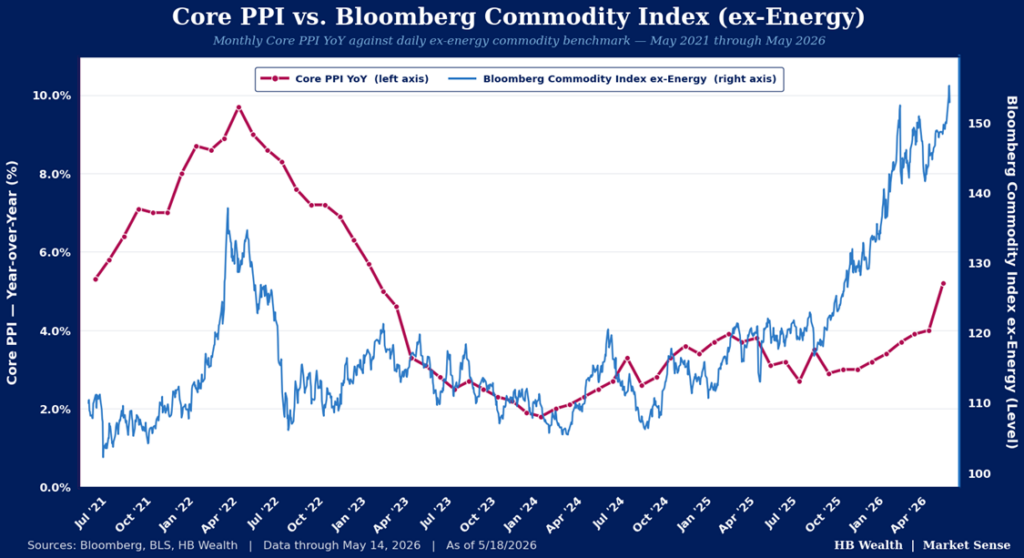
Input prices tied to industrial demand have made the most eye-popping gains. Copper prices just hit a new record high, reflecting electrification and data center construction. Silver prices remain below their speculative peak reached in January, but are still up more than 163% YoY. This is likely to pressure producer prices, which will most likely further fuel consumer prices in the months to come. The spring 2022 rise in ex-energy costs led to a spike in producer prices to near 9% within months. The ex-energy index surged beyond 2022’s peak the end of last year and has only carried on to new highs since, helping to fuel the recent rise in producer prices. Consumer prices are likely to feel the impact of the AI build as well. Electricity prices in CPI are now running at a pace of 5.6% YoY.
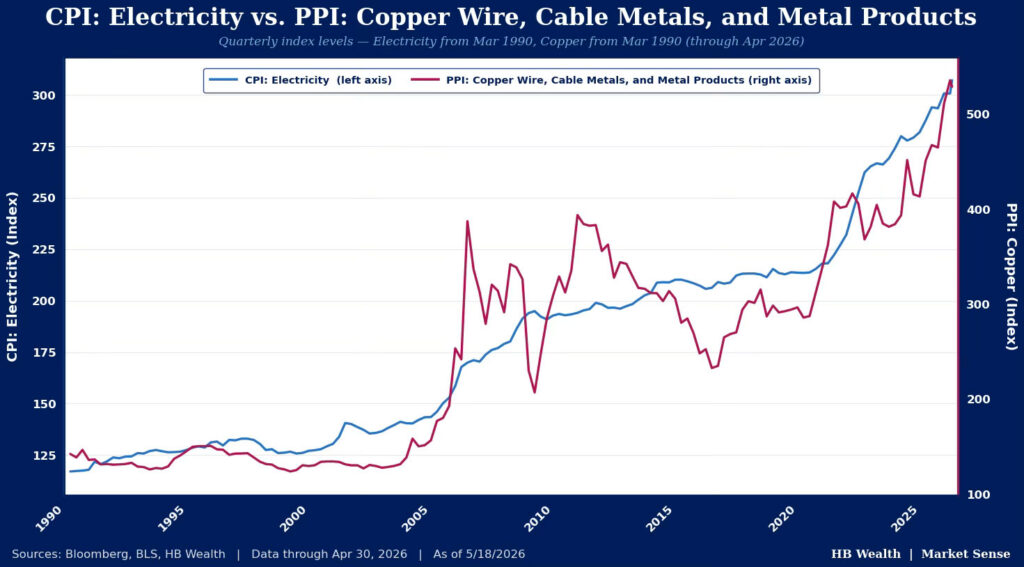
Cost cuts drove a tech earnings downdraft in the last inflation spike – 2022 – and that likely helped reduce inflation pressures in that cycle also riddled by supply disruptions due in part to war. Commodity costs have accelerated again with supply constraints from the Middle East, but this time cost cuts from tech are not likely forthcoming anytime soon. Instead, hyperscalers are expected to ramp up capex, growing spending by 71.8% in 2026 and 33.6% in 2027 to surpass $1 trillion. See our Deep Dive on the Magnificent-7’s earnings here.
The input cost inflation facing tech was different in 2022, as it was not driven by a surge in spending, but almost exclusively by supply chain strains. During that period, stocks were contending with a chip shortage driven by supply disruptions from the covid-19 pandemic. When inflation started running hot in mid-2021, that drove a sharp turn in sector earnings momentum, culminating in a three-quarter earnings recession from 3Q22-1Q23 that quickly followed inflation’s peak in mid-2022. During that downturn, semis led the EPS downdraft, averaging a 24.3% decline, followed by hardware (down 4.7%). Software (up 3.4%), resilient due to its asset-lite business model at the time, held up best. This time around, tech is driving the demand for commodities with robust spending plans. Thus, until spending eases are a major supply surge emerges, inflation may continue to run hot, with or without a re-opening of the Strait of Hormuz.
Disclosure: HB Wealth is an SECregistered investment adviser. The information reflects the author’s views, opinions, and analyses as the publication date. The information is provided for informational purposes only and does not constitute an offer to sell or a solicitation of an offer to buy any investment product. This information contains forward-looking statements, predictions, and forecasts (“forward-looking statements”) concerning the belief and opinions in respect to the future. Forward-looking statements involve risks and uncertainties, and undue reliance should not be placed on them. There can be no assurance that forward-looking statements will prove to be accurate, and actual results and future events could differ materially from those anticipated in such statements. The information does not represent legal, tax, accounting, or investment advice; recipients should consult their respective advisors regarding such matters. Certain information herein is based on third-party sources believed to be reliable, but which have not been independently verified. Past performance is not a guarantee or indicator of future results; inherent in any investment is the risk of loss.