









Growth Investing May Have Peaked with the Pandemic

A person with a backpack stands on a mountain ledge looking at distant blue hills. Text reads: “Market Sense by HB Wealth. Growth Investing May Have Peaked with the Pandemic. February 10, 2026.”.

After outperforming for most of the last three years, growth stocks have been struggling relative to value stocks since October of last year. However, the broad indices may be masking a longer-term shift in the styles’ performance. Pure style indices and a look beyond large caps both suggest the growth style may be further past its relative peak than is commonly believed.

The Russell 1000 growth index hit a new high in October of last year relative to the Russell 1000 value index, leading to the conclusion that growth stocks at large were still making new highs in comparison to value. However, a look under the hood of the popular style indices reveals a different take – that growth outperformance was not enough to recover the style’s losses to value in 2021-2022. Growth stocks may have merely managed by their late 2025 peak to fall just short of their 2020 high relative to value.
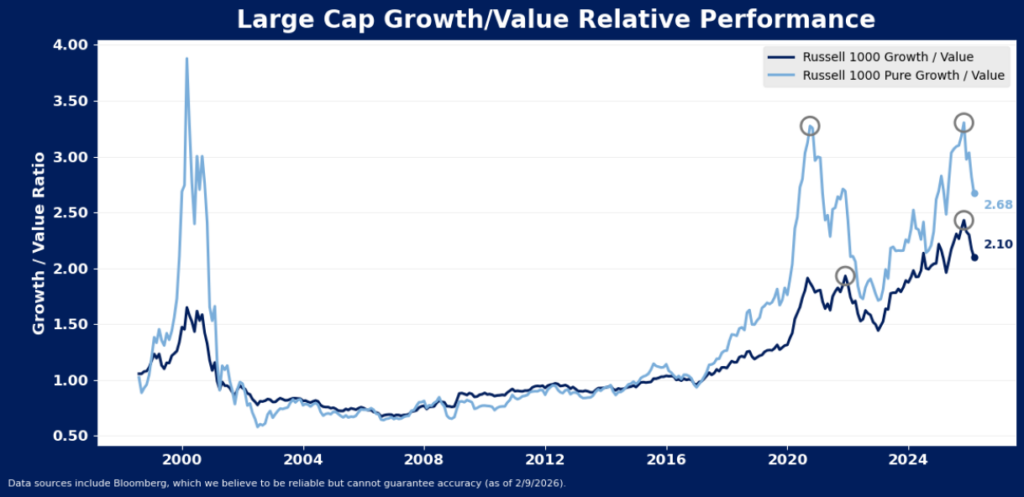
Line chart showing the Russell 1000 Growth/Value and Pure Growth/Value ratios from 2000 to 2024, highlighting peaks around 2000, 2021, and 2024 with latest values at 2.10 and 2.68, respectively.

Russell’s pure value and pure growth indices offer a finer take on style performance, as they have no overlapping constituents with one another. (On average, 25-30% of the constituents in the Russell 1000 growth index are also included in the value index. Thus, the pure indices can give an arguably clearer read on styles.) These indices show growth’s peak relative to value was all the way back in 2020 – the October 2025 peak in the Russell 1000 pure growth index relative to its value counterpart was slightly lower than the 2020 peak.

The small cap indices show a similar signal, though it is even clearer. In small caps, both the broad and the pure indexes show small cap growth peaked relative to small cap value in 2020, with the 2023-2025 rally resulting in a lower high for growth by comparison.
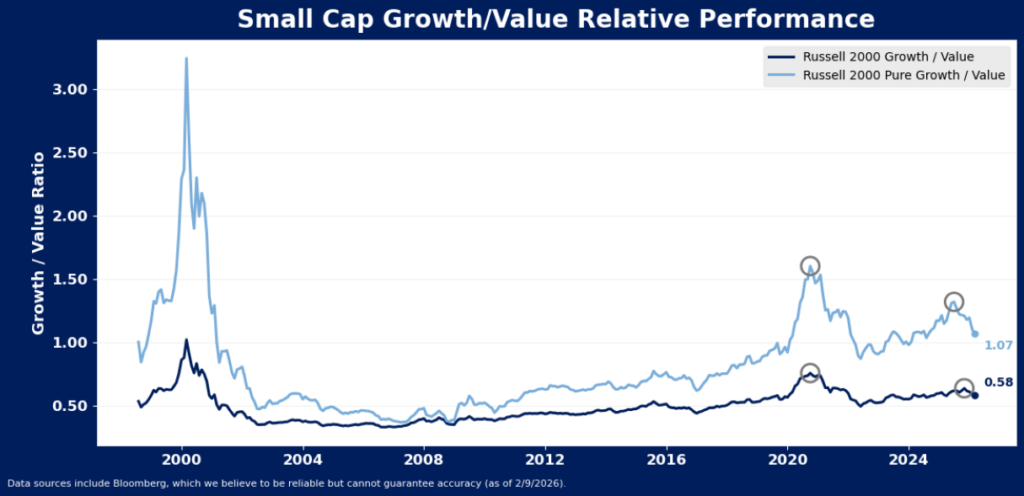
Line graph showing small cap growth/value performance from 1998 to 2024. The Russell 2000 Growth/Value ratio peaks around 2000 and 2021, then declines. The 2024 values are 1.07 for growth and 0.58 for pure growth.

Disclosure: HB Wealth is an SEC registered investment adviser. The information reflects the author’s views, opinions, and analyses as the publication date. The information is provided for informational purposes only and does not constitute an offer to sell or a solicitation of an offer to buy any investment product. This information contains forward-looking statements, predictions, and forecasts (“forward-looking statements”) concerning the belief and opinions in respect to the future. Forward-looking statements involve risks and uncertainties, and undue reliance should not be placed on them. There can be no assurance that forward-looking statements will prove to be accurate, and actual results and future events could differ materially from those anticipated in such statements. The information does not represent legal, tax, accounting, or investment advice; recipients should consult their respective advisors regarding such matters. Certain information herein is based on third-party sources believed to be reliable, but which have not been independently verified. Past performance is not a guarantee or indicator of future results; inherent in any investment is the risk of loss.

A woman with long brown hair wearing a blue blazer and a necklace smiles at the camera. The background is softly blurred with light and blue tones.

Gina Martin Adams, CFA, CMT

Chief Market Strategist, Shareholder

Gina Martin Adams, CFA, CMT, is the Chief Market Strategist for HB Wealth. With more than 25 years of experience at leading global financial institutions, Adams brings deep expertise in market analysis, thematic research, and translating complex economic trends into actionable strategies. She collaborates with HB Wealth’s investment team to deliver timely market perspectives, share actionable insights, and enhance the firm’s visibility as a leading voice in the industry. She contributes to advancing proprietary research, supporting the development of new investment products, and enhancing the client experience through thought leadership and education. She pursues a top-down perspective and model-based approach, leveraging fundamental, technical, and quantitative perspectives to inform investment decisions, and frequently presents her views in the media and at industry conferences, professional associations and investment organizations.

A young man with short brown hair, wearing a dark suit, white shirt, and blue tie, stands in front of a blurred background with lights and blue tones.

Matthew Sanders

Senior Investment Research Analyst

Related Insights & News

Companies Face a High Bar for 1Q Earnings Reports

Abstract: S&P 500 earnings face high hurdles this earnings season but given the ongoing conflict…

Read More

GDP Forecast is Under Fire. Why Aren’t Earnings Following Suit?

While strains from the conflict in Iran are already apparent in economists’ GDP forecasts, S&P…

Read More

Ceasefire Reduces Downside Risks but Supply Strains Remain a Drag

Ceasefire in the Middle East is undoubtedly encouraging news, and if it leads to peace…

Read More

Analysts May Need to Capitulate Before Stocks Can Make a Final Low

U.S. equity market valuations are starting to reflect inevitable inflation and growth risks of war…

Read More

The above is not a recommendation to purchase or sell a particular security and is not legal, investment or tax advice. Results are not guaranteed. All investing involves risk.

Past performance is not a guarantee of future results for any investment. Private alternative investments are not for every client. An individual must be qualified to invest in a private investment based on their net worth and/or other criteria, and they may qualify to invest in some alternative investments while not being allowed to invest in other alternative investments. Alternative investments are not risk-free and there is no guarantee of achieving attractive performance compared to similar liquid investments. Risks associated with investments in private alternatives include the illiquid nature of such investments, risks associated with leveraged investments, manager-specific risks, sector-specific risks, and in certain cases geographical risk, as well as the risk of loss of principal.