








Ceasefire in the Middle East is undoubtedly encouraging news, and if it leads to peace and stability in commodity prices and a stable reopening of the Strait of Hormuz, it could also help support the fundamental case for equities. However, even if peace is achieved in short order, earnings forecasts appear too high. Downward adjustments to expectations have likely just begun. History suggests elevated oil prices have a lagged impact on fundamental conditions, and as long as oil prices remain somewhat elevated, downward revisions may remain a drag on the resumed bull trend in stocks.
Historical Experience Suggests Earnings Impact Likely
Oil prices have dropped from extremes on news of ceasefire but are still about 50% above where they started the year. Unless oil prices ease back to pre-war levels soon, consensus forecasts for near-term earnings growth are likely to adjust lower, and this may effectively operate as a drag on any renewed bull trend
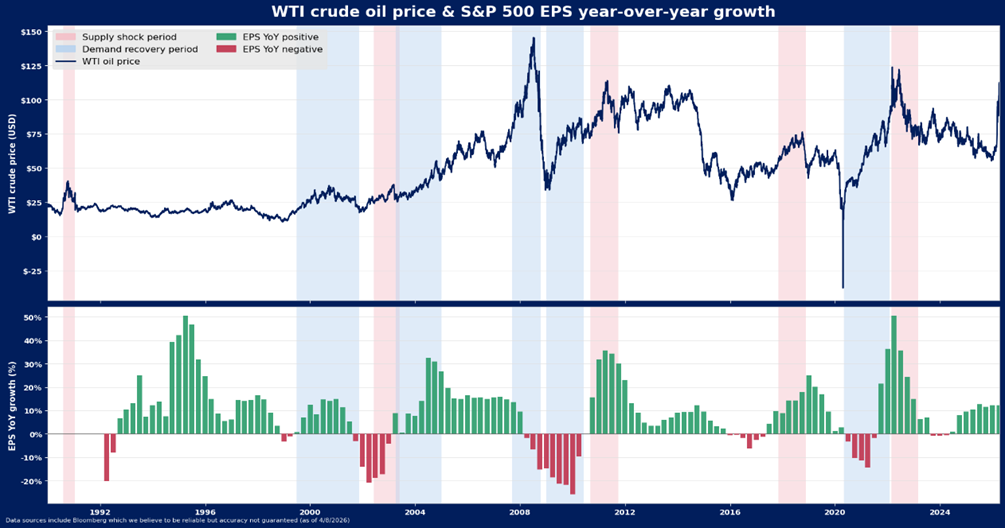
Disrupted supply in the Middle East risks extending the oil shock. Thanks to the conflict in Iran, global oil production has already slipped by ~8 million barrels per day (8% of total global supply), the worst production shock on record. In the worst of the 1990 Gulf War crisis, supply dropped 4.3 million barrels (6.5% of supply). In the 1973 oil embargo, 7% of supply was disrupted. The path to supply recovery could extend through the quarter, and has the potential to be quite disruptive to the S&P 500 earnings stream.
Oil shocks that last at least a quarter are relatively rare – occasionally resulting in periods of stagflation and earnings decline, ala the 1973 embargo, the early 1980s double-dip that was partially sparked by disruptions from the 1979 Iranian Revolution, and 2022’s near-miss of recession. We find 10 instances of oil price spikes of 50% or more that lasted at least three months since 1985 – half of which were the result of a supply shock. In the twelve months following these spikes real GDP rose just 1.8% on average and S&P 500 earnings fell -0.5% on average. Notably, oil prices and earnings are positively correlated – earnings tend to go higher as oil prices rise and the earnings downside of the price shock does not typically emerge until the shock itself has peaked.
Analysts Forecasts Diverge from Macro Cues
Earnings risks from the commodity supply shock are not yet embedded in consensus expectations and are likely to emerge in the coming quarter. Analysts are forecasting 17% earnings growth for the S&P 500 in 2026, and 16.2% growth excluding the Mag-7. While part of this is due to an expected turnaround for the energy sector, from -10% last year to more than 25% growth this year, ex-energy earnings are also expected to rise 16.6% this year. Over the next twelve months, analysts are still anticipating greater than 20% growth.
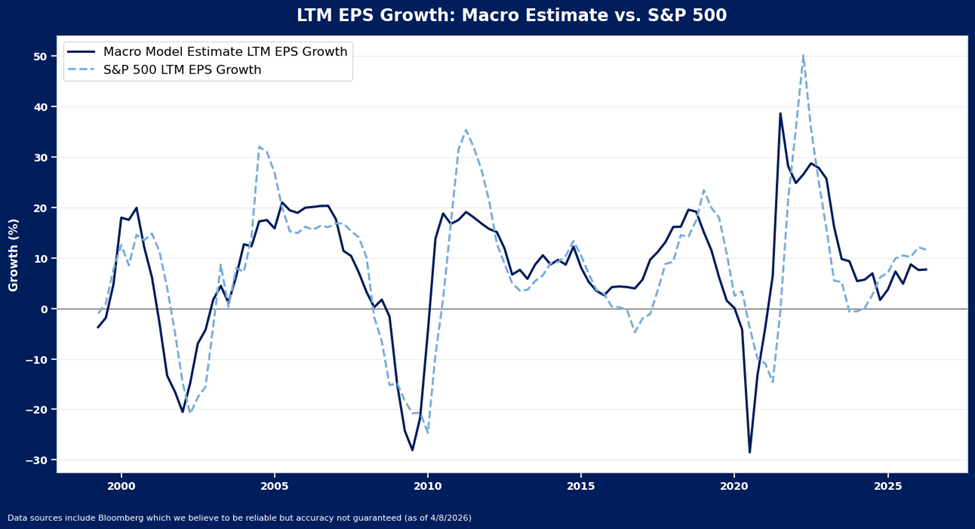
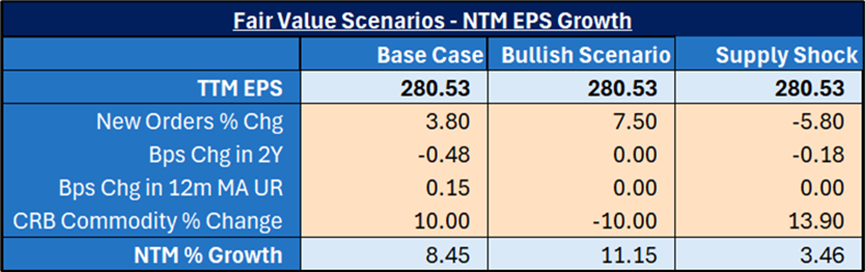
These forecasts for strong earnings growth contrast with current macroeconomic trends, which currently imply growth of closer to 8%. Our macro-based model for earnings growth relies on the indicators that have historically offered predictive value for corporate earnings – investment, employment, changes in short-term rates and commodity prices. In any scenario we design, analyst estimates are too high. Current economic consensus around these indicators, which presumes a near term reprieve for commodity price pressures, suggests 8.5% EPS growth over the next twelve months versus the analyst consensus for 20.1%.
Even a quick resolution to the conflict (a bullish scenario) is likely to deliver just 11.2% bottom-line growth if the Fed keeps rates steady as commodity prices slowly normalize and the economy accelerates. If instead a scenario akin to the five historical supply-driven oil price spikes we analyzed emerges – one where new orders falls 5.8%, 2-year treasury yields slip by 18 bps, employment holds firm and commodities return to their post-pandemic high – earnings could rise merely 3.5%.
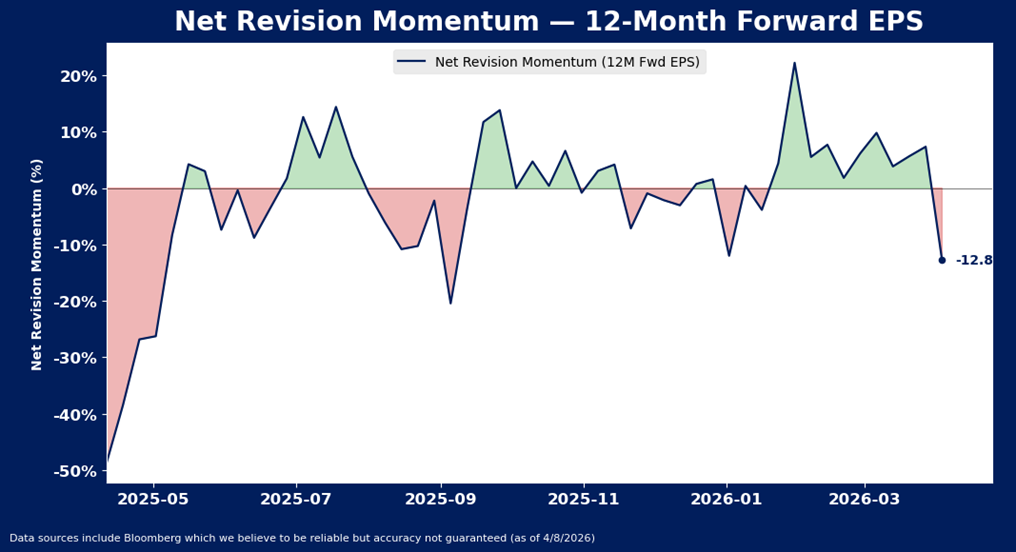
Analysts have started to mark down estimates, but not materially so, compared to past earnings seasons. Index level revision momentum dropped last week for the first time since December, as downward revisions in consumer and industrials segments of the index finally started to overwhelm the whole. In fact, since the start of the war, consensus has started to trim discretionary, industrials and staples 1Q-2Q26 EPS forecasts. Likewise, while chemicals and metals & mining are buoying materials sector estimates, analysts have taken an axe to construction materials and containers & packaging forecasts. Consumer-related sectors, especially discretionary, non-defense industrials and swaths of materials earnings likely remain most at risk of negative revisions should oil prices remain higher for longer.
Helping to offset those sectoral strains, the S&P 500’s concentration in tech and tech-like sectors may be a blessing in disguise, for it weakens linkages to typical measures of economic activity and blunts the worst of any oil-driven degradation of the overall earnings stream.
Market technicals have improved materially with ceasefire in the Middle East, reducing the likelihood of a bear trend emerging for stocks. However, an uncertain path to durable peace and a long runway for rebuilding supply may keep commodity prices elevated and supply chains strained. Our macro-based model points to a lighter earnings recovery than consensus anticipates even if peace emerges in short order, with greater downside if oil prices remain high. Oil price shocks have consistently led to slowdown in earnings growth historically, contrary to analyst expectations for very robust earnings growth this year. Consumer, non-defense industrial stocks and swaths of materials may remain most at risk, while tech and tech-adjacent equities could offer portfolio ballast as forecast adjustments to the oil price shock emerge.
Disclosure: HB Wealth is an SEC-registered investment adviser. The information reflects the author’s views, opinions, and analyses as the publication date. The information is provided for informational purposes only and does not constitute an offer to sell or a solicitation of an offer to buy any investment product. This information contains forward-looking statements, predictions, and forecasts (“forward-looking statements”) concerning the belief and opinions in respect to the future. Forward-looking statements involve risks and uncertainties, and undue reliance should not be placed on them. There can be no assurance that forward-looking statements will prove to be accurate, and actual results and future events could differ materially from those anticipated in such statements. The information does not represent legal, tax, accounting, or investment advice; recipients should consult their respective advisors regarding such matters. Certain information herein is based on third-party sources believed to be reliable, but which have not been independently verified. Past performance is not a guarantee or indicator of future results; inherent in any investment is the risk of loss.