







Stocks-Bonds Correlation Flags Risk of Renewed Volatility

The correlation between U.S. equity prices and bond yields is signaling another risk-off period may be lurking.  The asset classes move in regimes – the correlation between stock prices and bond yields was largely positive from 2000-2022 as equities tended to move in the direction of yields as inflation mostly coincided with growth. Stocks held a negative correlation to yields from the 1970s through the 1990s, when inflation hurt stocks, and that phenomenon returned with 2022 bear market.
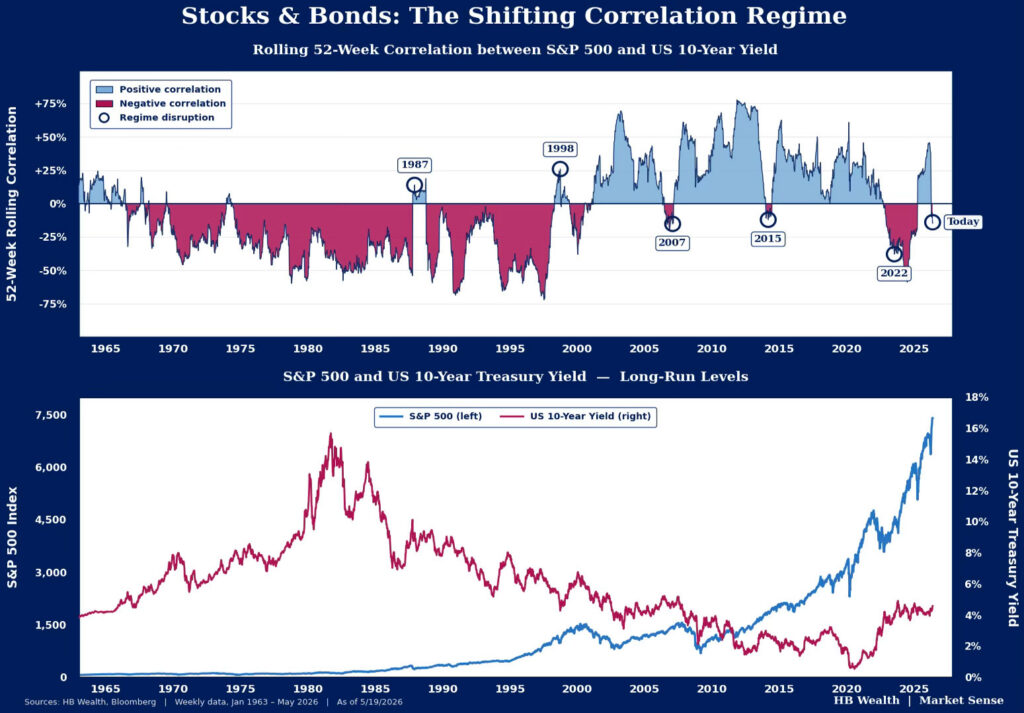
Historically, equity market corrections have occurred when the correlation departed from its primary regime. Disruptions to the persistently negative correlation regime in the 80s and 90s occurred in 1987 and 1998, as correlations shifted positively. Likewise, disruptions to the positive correlation regime of the post-2000 period occurred just before the 2007 and 2015 peaks in stocks, and again in 2022.  After holding a positive regime stance since April 2025, the correlation has once again lost its bearings and has rapidly shifted into negative territory. 

While the stocks-bonds correlation is just one of 13 signals we utilize for assessing the near-term outlook for stocks, it is now a detracting factor.  Inflation is once again a nag on financial assets.


Disclosure: HB Wealth is an SECregistered investment adviser. The information reflects the author’s views, opinions, and analyses as the publication date. The information is provided for informational purposes only and does not constitute an offer to sell or a solicitation of an offer to buy any investment product. This information contains forward-looking statements, predictions, and forecasts (“forward-looking statements”) concerning the belief and opinions in respect to the future. Forward-looking statements involve risks and uncertainties, and undue reliance should not be placed on them. There can be no assurance that forward-looking statements will prove to be accurate, and actual results and future events could differ materially from those anticipated in such statements. The information does not represent legal, tax, accounting, or investment advice; recipients should consult their respective advisors regarding such matters. Certain information herein is based on third-party sources believed to be reliable, but which have not been independently verified. Past performance is not a guarantee or indicator of future results; inherent in any investment is the risk of loss.

A woman with long brown hair wearing a blue blazer and a necklace smiles at the camera. The background is softly blurred with light and blue tones.

Gina Martin Adams, CFA, CMT

Chief Market Strategist, Shareholder

Gina Martin Adams, CFA, CMT, is the Chief Market Strategist for HB Wealth. With more than 25 years of experience at leading global financial institutions, Adams brings deep expertise in market analysis, thematic research, and translating complex economic trends into actionable strategies. She collaborates with HB Wealth’s investment team to deliver timely market perspectives, share actionable insights, and enhance the firm’s visibility as a leading voice in the industry. She contributes to advancing proprietary research, supporting the development of new investment products, and enhancing the client experience through thought leadership and education. She pursues a top-down perspective and model-based approach, leveraging fundamental, technical, and quantitative perspectives to inform investment decisions, and frequently presents her views in the media and at industry conferences, professional associations and investment organizations.

A young man with short brown hair, wearing a dark suit, white shirt, and blue tie, stands in front of a blurred background with lights and blue tones.

Matthew Sanders

Senior Investment Research Analyst

A man in a blue suit and tie smiles at the camera against a blurred blue and white background.

Michael Casper, CFA

Director, Senior Market Strategist

Related Insights & News

Stocks are Frothy, but This Bull Isn’t Yet a Tech Bubble Repeat

Abstract: U.S. stocks’ multi-year rally looks eerily similar to textbook bubbles that formed ahead of…

Read More

As AI Fireworks Fade, Smaller Caps May Maintain Spark

Abstract: The undercurrents of the equity market are worth paying attention to, for while parabolic…

Read More

Market Sense Monthly: Top Takes

May’s Top Take – Earnings Make the World Go Round If May proved anything it’s…

Read More

Global Stocks Should Help Diversify Equity Portfolios, at a Low Relative Cost

Abstract: Adding nondomestic stocks to an equity portfolio has clear diversification benefits, and both emerging…

Read More

The above is not a recommendation to purchase or sell a particular security and is not legal, investment or tax advice. Results are not guaranteed. All investing involves risk.

Past performance is not a guarantee of future results for any investment. Private alternative investments are not for every client. An individual must be qualified to invest in a private investment based on their net worth and/or other criteria, and they may qualify to invest in some alternative investments while not being allowed to invest in other alternative investments. Alternative investments are not risk-free and there is no guarantee of achieving attractive performance compared to similar liquid investments. Risks associated with investments in private alternatives include the illiquid nature of such investments, risks associated with leveraged investments, manager-specific risks, sector-specific risks, and in certain cases geographical risk, as well as the risk of loss of principal.