








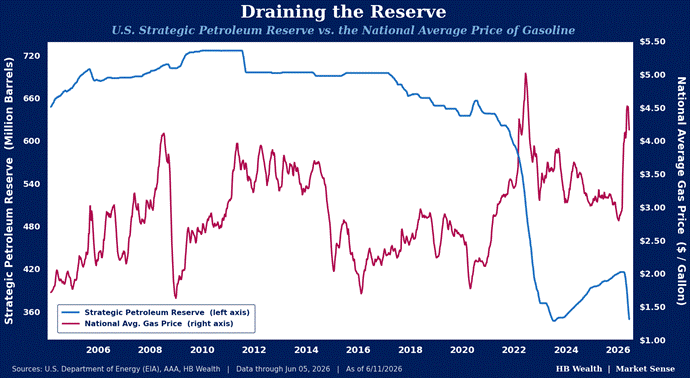
The US’ strategic petroleum reserve (SPR) is hitting some of the lowest levels since the 1980s as drawdowns reaccelerated with the conflict in Iran and could approach its lower limits if a proposed peace deal falls through yet again or if traffic in the Strait of Hormuz remains limited. The physical floor – roughly 20% of maximum storage – is still quite a way away but certainly limits the amount that can be pushed to the market if the Strait doesn’t reopen soon. Should the lower limit approach, it would hamstring the ability of the government to offset higher crude prices and continue to apply upward pressure to inflation. That could likewise keep rates higher for longer as the Fed is either forced to hold or even tighten to combat rising prices.
SPR Used to Combat Gas Price Pressure, Floor Could Limit Efficacy
Throughout history, the SPR has been used to combat prices at the pump with the most severe drawdowns occurring coincident to spiking gasoline. Prior to the conflict in Iran, the SPR fell by 262.6 million barrels during the pandemic and subsequent Ukraine war as the government sought to ease consumer stress as the national average gas price pierced $5/gallon by mid-2022. Likewise, as prices at the pump have gotten close to $4.50 during the conflict with Iran, the SPR has been drawn down by another 66.2 million barrels to 349.2 million. Estimates suggest the floor is at about 20% of max capacity or 140 million barrels and as that level approaches, the government could lose a key tool they’ve used to limit the hit to the consumer.
Though services have been the biggest contributor to resurgent consumer inflation, rising energy prices are the second biggest share, and a similar dynamic is apparent within producer prices. The Fed typically leans on core measures of inflation to set rate-policy but Kevin Warsh’s elevation to chair might result in alternative measures – mainly trimmed mean inflation – being used instead. Rather than removing food and energy from the equation blindly every month, trimmed mean removes any categories that register as outliers. This raises the risk of higher energy prices filtering through rate policy as well.
Disclosure: HB Wealth is an SEC registered investment adviser. The information reflects the author’s views, opinions, and analyses as the publication date. The information is provided for informational purposes only and does not constitute an offer to sell or a solicitation of an offer to buy any investment product. This information contains forward-looking statements, predictions, and forecasts (“forward-looking statements”) concerning the belief and opinions in respect to the future. Forward-looking statements involve risks and uncertainties, and undue reliance should not be placed on them. There can be no assurance that forward-looking statements will prove to be accurate, and actual results and future events could differ materially from those anticipated in such statements. The information does not represent legal, tax, accounting, or investment advice; recipients should consult their respective advisors regarding such matters. Certain information herein is based on third-party sources believed to be reliable, but which have not been independently verified. Past performance is not a guarantee or indicator of future results; inherent in any investment is the risk of loss.