







S&P 500 Earnings Outlook is Leaning on Energy

Earnings season is helping to boost the mood for equity markets. Despite souring economic data at the tail end of Q1, the S&P 500 is on track to record about 12.4% YoY EPS growth for the quarter. This is in line with the pre-season expectation, and a modest slowdown from 13.2% YoY growth recorded in the January reporting season. However, the expectation for 2026 growth has only gone higher in recent weeks, boosted by the increase in expectations for the energy sector.  Prior to the war, the energy sector was expected to be a drag on S&P 500 earnings this year, but over the last six weeks, expectations have soared. The sector is now expected to post earnings growth of more than 40% in 2026.  Though higher energy prices are also eroding the outlook for other segments, such as discretionary and industrials, the energy sector boost has more than offset the downside effect on other segments.
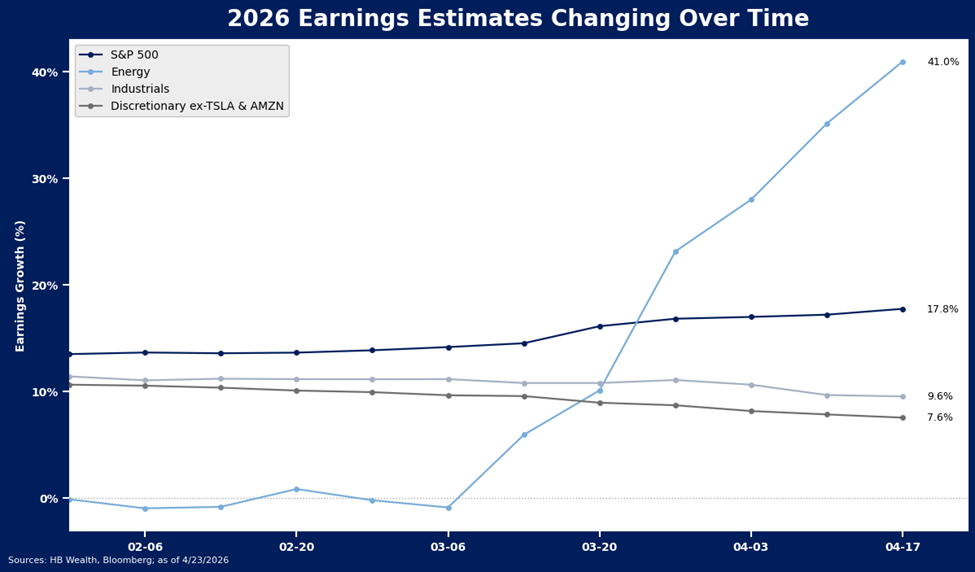
Line chart showing 2026 earnings estimates growth over time for four categories: Energy rises sharply to 41%, Discretionary ex-TSLA & AMZN to 17.8%, while S&P 500, Industrials, and Energy stay below 10%, from 02-06 to 04-17.

Disclosure: HB Wealth is an SECregistered investment adviser. The information reflects the author’s views, opinions, and analyses as the publication date. The information is provided for informational purposes only and does not constitute an offer to sell or a solicitation of an offer to buy any investment product. This information contains forward-looking statements, predictions, and forecasts (“forward-looking statements”) concerning the belief and opinions in respect to the future. Forward-looking statements involve risks and uncertainties, and undue reliance should not be placed on them. There can be no assurance that forward-looking statements will prove to be accurate, and actual results and future events could differ materially from those anticipated in such statements. The information does not represent legal, tax, accounting, or investment advice; recipients should consult their respective advisors regarding such matters. Certain information herein is based on third-party sources believed to be reliable, but which have not been independently verified. Past performance is not a guarantee or indicator of future results; inherent in any investment is the risk of loss.

A young man with short brown hair, wearing a dark suit, white shirt, and blue tie, stands in front of a blurred background with lights and blue tones.

Matthew Sanders

Senior Investment Research Analyst

A young man with short brown hair, wearing a dark suit, white shirt, and blue tie, stands in front of a blurred background with lights and blue tones.

Matthew Sanders

Senior Investment Research Analyst

A man in a blue suit and tie smiles at the camera against a blurred blue and white background.

Michael Casper, CFA

Director, Senior Market Strategist

Related Insights & News

With Small Caps Leading the Way, U.S. Stocks’ Role Reversal Has Legs

 Abstract: Russell 2000 Is Getting Sparks from Revenues, Macro and M&A Small cap stocks have…

Read More

Tech Stocks Look Discounted but the Devil is in the Details

Abstract: Discounted forward valuations are giving some investors the impression that the tech sector is…

Read More

Companies Face a High Bar for 1Q Earnings Reports

Abstract: S&P 500 earnings face high hurdles this earnings season but given the ongoing conflict…

Read More

GDP Forecast is Under Fire. Why Aren’t Earnings Following Suit?

While strains from the conflict in Iran are already apparent in economists’ GDP forecasts, S&P…

Read More

The above is not a recommendation to purchase or sell a particular security and is not legal, investment or tax advice. Results are not guaranteed. All investing involves risk.

Past performance is not a guarantee of future results for any investment. Private alternative investments are not for every client. An individual must be qualified to invest in a private investment based on their net worth and/or other criteria, and they may qualify to invest in some alternative investments while not being allowed to invest in other alternative investments. Alternative investments are not risk-free and there is no guarantee of achieving attractive performance compared to similar liquid investments. Risks associated with investments in private alternatives include the illiquid nature of such investments, risks associated with leveraged investments, manager-specific risks, sector-specific risks, and in certain cases geographical risk, as well as the risk of loss of principal.