









Abstract:
- Equity and debt markets may continue to struggle with the notion of peak AI profits growth, but there may be a much longer runway for AI-related improvements to emerge in the broader economy.
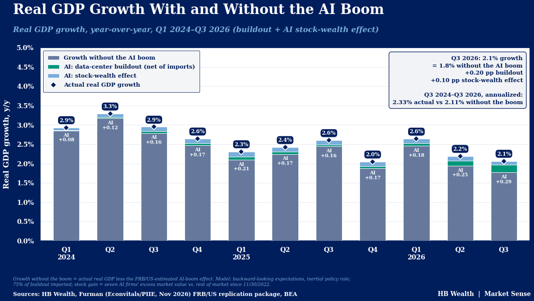
- AI is helping to offset slow GDP growth, not creating a surge in economic growth. Since the beginning of 2024, U.S. real GDP growth has averaged annualized growth of 2.3%. Without AI, growth would have averaged 2.1%.
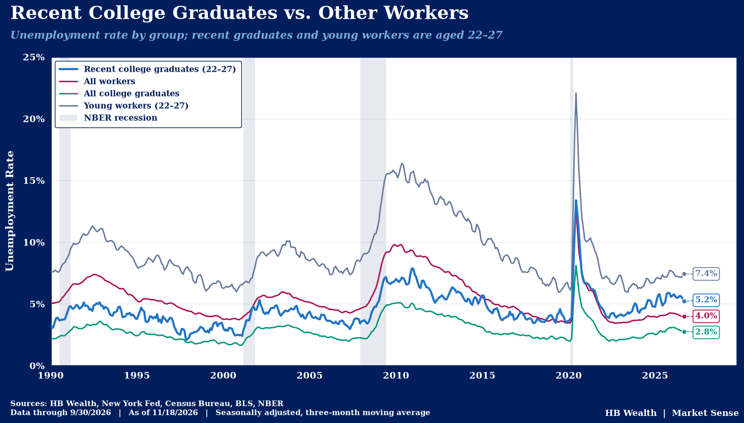
- Unemployment for college grads pre-dates AI. It is higher for new graduates in the pandemic era for a host of reasons, but evidence that AI is displacing jobs is lacking. Recent college graduates’ unemployment rate is 5.2%, above the general level of 4% for the 23rd consecutive quarter.
- Productivity growth was 3.6% annualized in the third quarter but just 2.1% over the past year, in line with its 2.2% long-run average, suggesting that at best, AI is in the early stages of impacting efficiency in the business sector.
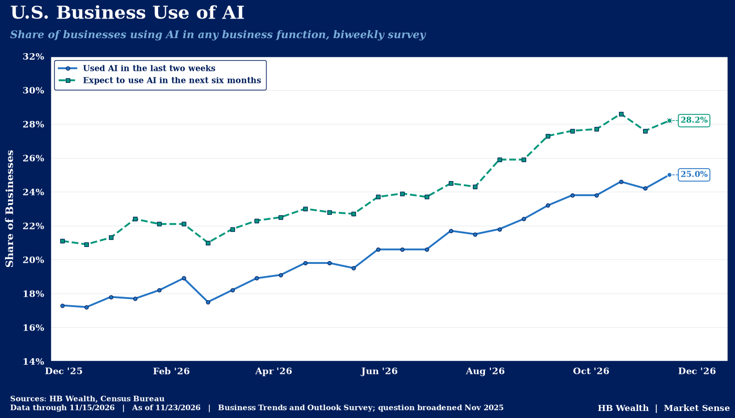
- Low adoption and utilization rates for the new technology will need to shift into high gear before stronger economic impacts emerge. The Census Bureau estimates that only 25.0% of US businesses currently are utilizing AI, and 28.2% plan to use it in the next six months.
AI has had an enormous impact on corporate earnings and the stock market, accounting for 59% of earnings growth and 49% of S&P 500 price growth since the beginning of 2024. However, it has only moderately moved the needle on economic growth or employment conditions. Productivity growth has likewise only just started to increase, as just 25.0% of U.S. businesses, according to the Census Bureau, are currently utilizing the new technology. Thus, while equity and debt markets may continue to struggle with the notion of peak growth and heavy funding pressures, there may be a much longer runway for AI-related improvements to emerge in the broader economy.
Here is the story of AI’s impact on the economy, told through 4 charts:
There is No Evidence to Suggest AI is Amping up GDP Yet.
In fact, U.S. GDP would have been below average without AI. Since the beginning of 2024, U.S. real GDP growth has averaged annualized growth of 2.3%. This is nearly precisely the average growth rate of 2.3% recorded in the years between the Great Financial Crisis and the 2020 Covid recession. AI, through both the data center buildout and the stock market wealth effect accounted for an estimated 0.22 percentage points of GDP during that time, suggesting that without AI, growth would have been just 2.1%.
Imports Reduce the Economic Impact of AI Materially, as Inputs for the Boom Come from Outside the U.S.
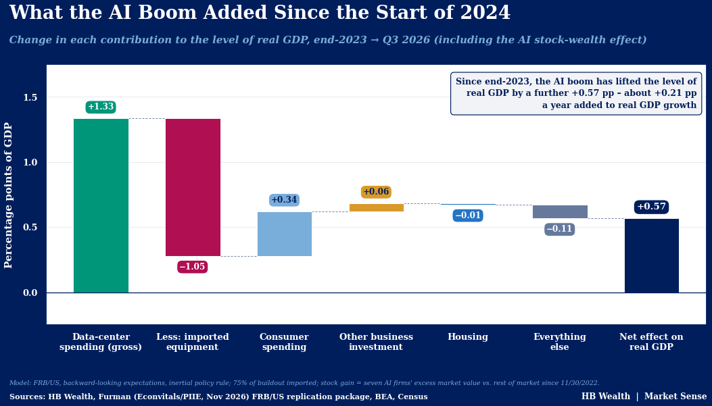
The net cumulative effect of the AI investment boom on GDP since the start of 2024 has been 0.57 percentage points, as boosts from data center spending, other business investment as a trickle-down effect from direct AI investment, and the wealth effect on consumer spending have all added to growth. Offsetting the large 1.33 percentage point 19% of GDP growth) boost from data centers is the 1.05 percentage point (15% of GDP growth) drag from imports of equipment utilized in the build.
College Grads are Struggling More than Usual to Find Jobs, But its Not Because of AI.
Fears that AI is displacing workers are so far largely unfound. While recent college graduates’ unemployment rate is 5.2%, above the general level of 4% for the 23rd consecutive quarter, studies from the Federal Reserve, NBER and Universities such as UCLA have all shown that AI is so far not a material driver of higher unemployment rates among new graduates. Given trends in graduate unemployment predate generative AI, proximate causes for unemployment are more likely to be general labor market weakness amid high inflation as well as the Covid-era transition to remote work.
Productivity May Get a Boost, But Just 24% of Businesses Use AI.
Productivity growth was 3.6% annualized in the third quarter but just 2.1% over the past year, in line with its 2.2% long-run average, suggesting that at best, AI is in the early stages of impacting efficiency in the business sector. This may be in part because of relatively low adoption and utilization rates for the new technology. The Census Bureau Business Trends and Outlook Survey shows that only 25.0% of US businesses currently are utilizing AI, and 28.2% plan to use it in the next six months. While that is up from 17% and 21%, respectively at the start of the year, it also suggests that there is plenty of runway for adoption of the technology, and potential for productivity enhancement as a result.
Disclosure: HB Wealth is an SEC‑registered investment adviser. The information reflects the author’s views, opinions, and analyses as the publication date. The information is provided for informational purposes only and does not constitute an offer to sell or a solicitation of an offer to buy any investment product. This information contains forward-looking statements, predictions, and forecasts (“forward-looking statements”) concerning the belief and opinions in respect to the future. Forward-looking statements involve risks and uncertainties, and undue reliance should not be placed on them. There can be no assurance that forward-looking statements will prove to be accurate, and actual results and future events could differ materially from those anticipated in such statements. Any estimates in this commentary, including estimates of how much AI has contributed to GDP, earnings or market returns, are based on the author’s analysis and assumptions and are not guaranteed. The S&P 500 Index is an unmanaged index of large-capitalization U.S. stocks. Its performance does not reflect fees, expenses or taxes, and investors cannot invest directly in an index. References to AI or AI-related companies describe broad market and economic themes. The information does not represent legal, tax, accounting, or investment advice; recipients should consult their respective advisors regarding such matters. Certain information herein is based on third-party sources believed to be reliable, but which have not been independently verified. Past performance is not a guarantee or indicator of future results; inherent in any investment is the risk of loss.