









Abstract:
- Jensen Huang’s departure from Nvidia threatens to unravel a web of financing in the AI industry, particularly if company revenues are dinged by regulatory backlash from the ex-CEO’s affair with a Chinese spy. The company affirmed contingencies around some of its commitments in its earnings release, and any China-related revenue hit from tighter export restrictions remains a critical trigger to watch given Nvidia’s role in the AI ecosystem.
- The company is central to the AI ecosystem, with 98 relationships among 35 companies across eight layers of the AI build-out, supplying 12 companies, buying from 8, and financing 10. Two major neoclouds – CoreWeave and Iren – are financed by Nvidia and are both customer (purchasing Nvidia chips) and supplier (Nvidia purchasing unused compute capacity) – putting them at notable risk.
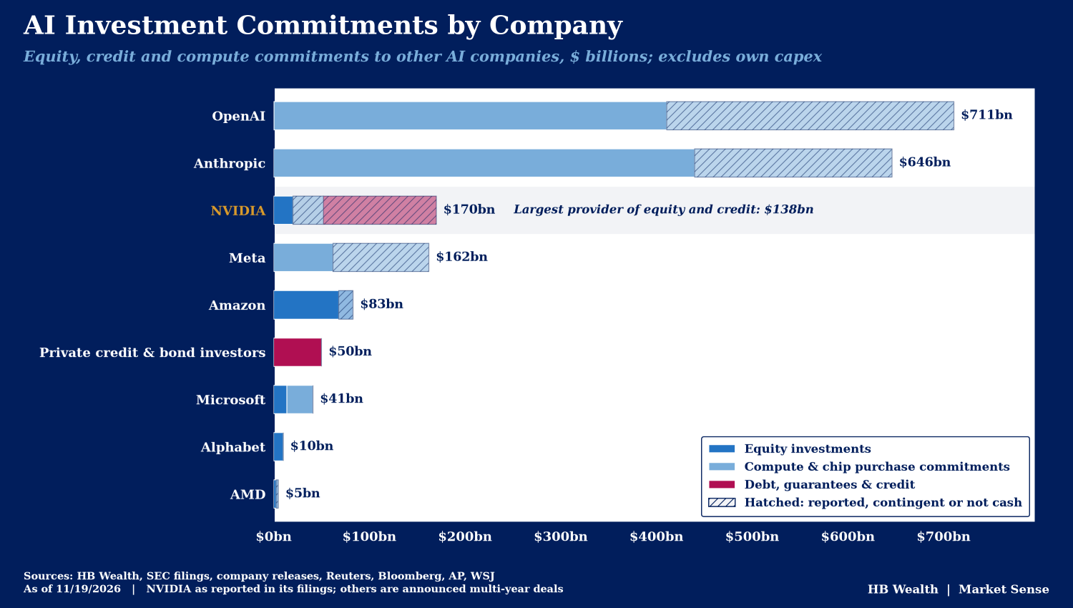
- While NVDA’s $170 billion of commitments to other AI companies is small in comparison to hyperscaler expected capex of $1.2 trillion in 2027, it is still the largest single source of equity and credit in our analysis. Only OpenAI ($711 billion) and Anthropic ($646 billion) have committed more in total, and almost all of that is compute and equipment it has agreed to buy rather than capital it provides. Meta ($162 billion) rounds out the top four.
- Even if China revenue vanished entirely, estimates imply the SOX would still post a 29.7% sales gain next year – strong, but down from 2026’s 68.6% pace. Removing all disclosed China revenue would likewise cut the S&P 500’s and AI suppliers’ 2027 topline growth by roughly 2.3 and 13.7 percentage points, to 6.5% and 29.3%, respectively.
One of the biggest consequences of the Jensen Huang saga at Nvidia may be a role reduction for the company as circular financier of the AI buildout. This could happen directly, as a consequence of the removal of the dealmaker, and indirectly, through regulatory backlash to address security risks that have surfaced following the revelation of the ex-CEO’s affair with an alleged Chinese spy. As noted in Nvidia’s earnings release, it appears the neoclouds are most vulnerable to gaps in funding and unused capacity, should Nvidia’s revenues be impacted. While it’s important to remember that hyperscaler capex is still the driving force behind AI, a negative feedback loop that hits Nvidia itself and dents the rate of growth in the rest of the AI-ecosystem isn’t out of the question.
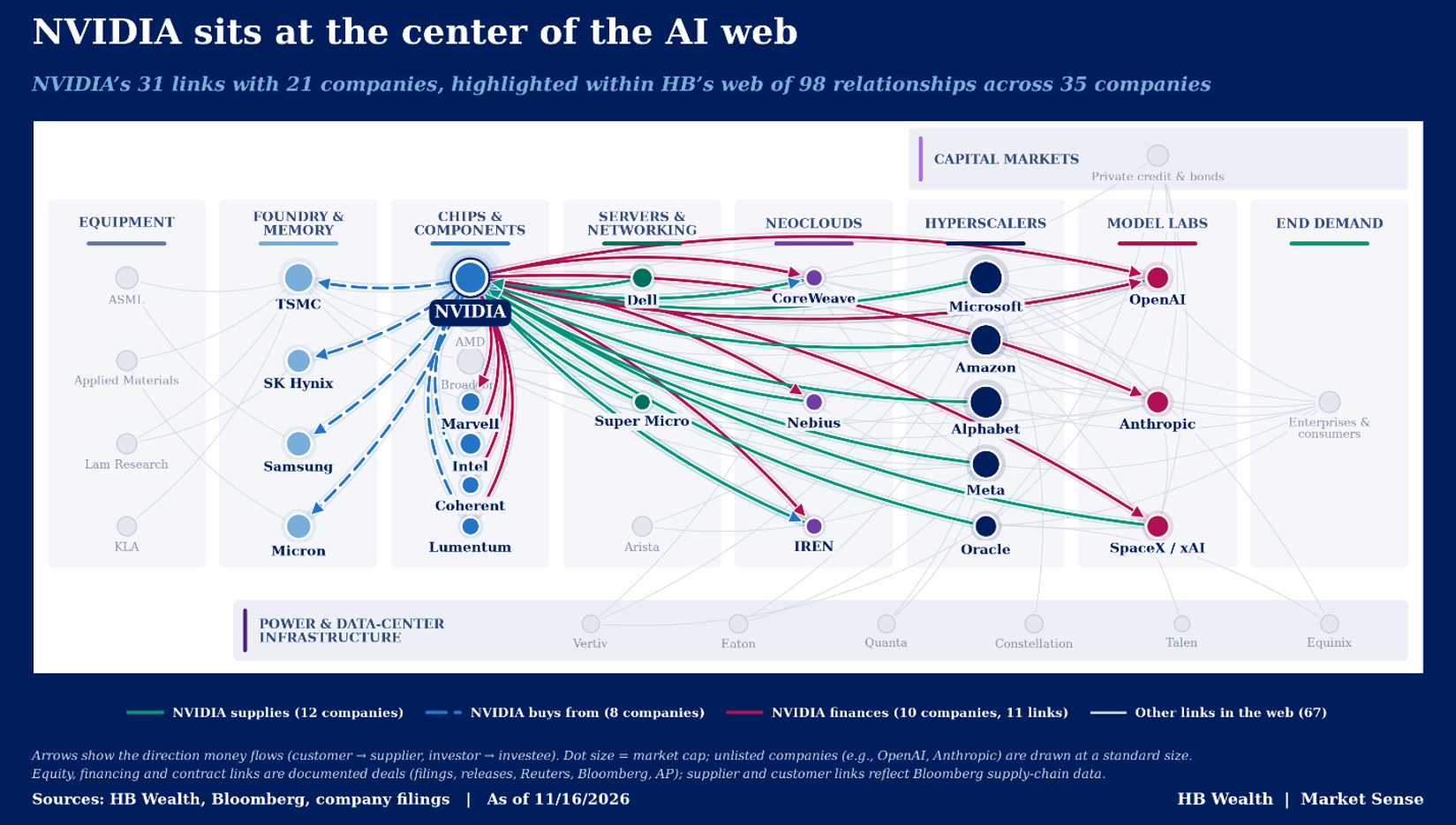
We mapped 98 relationships among 35 companies across eight layers of the AI build-out, in addition to end customers and credit markets. These companies belong to industry segments such as equipment, foundry and memory, chips and components, servers and networking, neoclouds, hyperscalers, model labs, and power and data infrastructure. Relationships included in the web come from six different areas — chip and hardware purchases, equity stakes, cloud computing contracts, power and data-center infrastructure, end-customer demand, and debt, leases, and guarantees – and Nvidia is linked with 21 companies, several with multiple dependencies. It supplies 12 of these companies, buys from 8, and finances 10. Of those, just two major neoclouds – CoreWeave and Iren – are financed by Nvidia and are both customer (purchasing Nvidia chips) and supplier (Nvidia purchasing unused compute capacity) – putting them at notable risk. But risk is not limited to the neoclouds.
Huang Departure and Curtailment of China Sales May Limit Nvidia Role in Funding AI
Jensen Huang’s departure from Nvidia could reduce the flow of funds supporting the AI theme at large, as he played a central role in formulating the company as financier of the build. Indeed, of the $668 billion in commitments and guarantees in Nvidia’s latest filings, most is supply purchases, but roughly $170 billion directly supports other AI companies: up to $118 billion of guarantees (including up to $105 billion backing OpenAI’s data center lease and power payments), $32 billion of agreements to buy cloud capacity from neoclouds such as CoreWeave and IREN, and $20 billion of equity investments still to be funded. That comes on top of about $110 billion of equity stakes it already holds. This makes Nvidia the largest single source of equity and credit in our analysis, ahead of Amazon ($83 billion) and private credit and bond investors ($50 billion). Only OpenAI ($711 billion) and Anthropic ($646 billion) have committed more in total, and almost all of that is compute and equipment they have agreed to buy rather than capital they provide. However, it’s worth noting that Nvidia’s commitments pale in comparison to hyperscaler planned capex ($1.2 trillion in 2027).
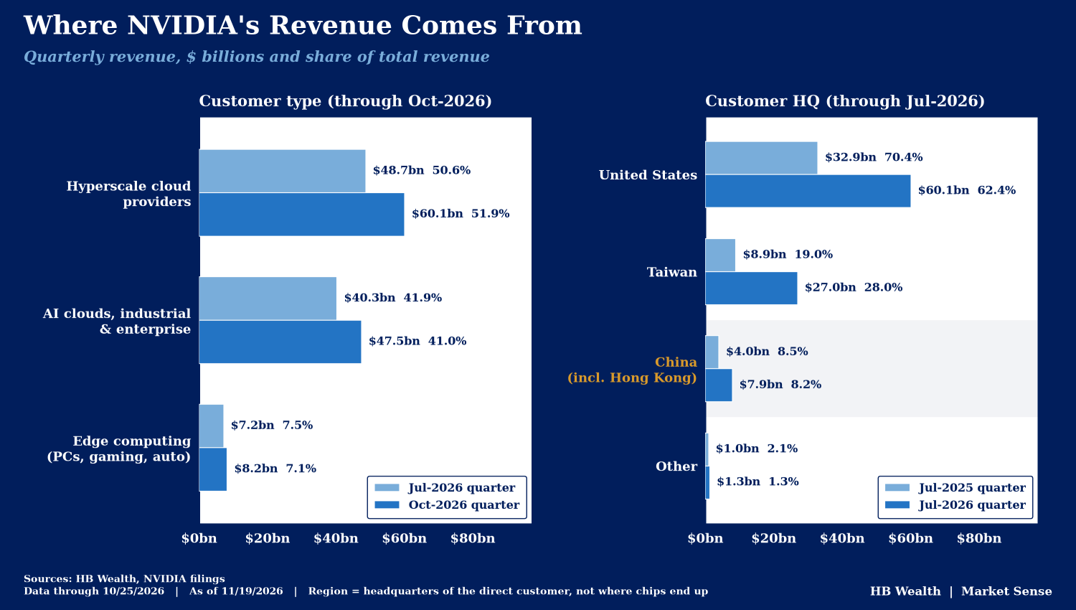
Beyond departure of the dealmaker, the security risks uncovered by the CEO’s affair and dealings with companies in and around China could further restrict money flows in the sector at large, via regulatory pressures on the industry and export restrictions on its products. In our Chart of the Week on November 13th, we pointed out that Congress could attempt to tighten export controls given the news that Nvidia chips were illegally making their way to China. Based on publicly filed data, 6% of the company’s revenue could be impacted in such a worst-case scenario. This figure likely understates sales to the country given the possibly illicit nature of the dealings and indirect sales to China through Southeast Asia. Nonetheless, any curtailment of the significant portion of Nvidia’s revenue and subsequently cash flows that comes from China sales might dent company efforts to fund other areas of the AI buildout.
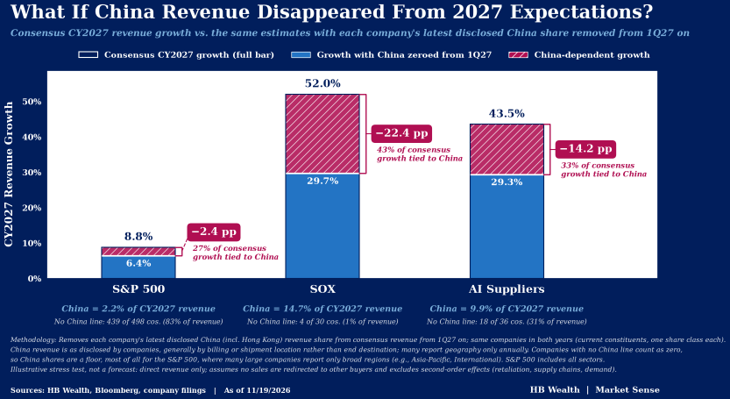
Likewise, tighter export restrictions could have a material impact on overall index, semiconductor, and AI supplier revenues. Currently, a relatively small 2.3 percentage points of S&P 500 revenue growth is expected to come from China in 2027. However, 21.7 and 13.7 percentage points of the Philadelphia Semiconductor Index (SOX) and AI supplier’s topline growth is forecast to come from China next year. Even if all revenues from China vanished, estimates imply the SOX would still post 29.7% sales growth next year. While this is still extremely robust, it would mark a sharp deceleration from 2026’s 68.6% pace. Removing all disclosed China revenue would likewise drop the S&P 500 and AI suppliers 2027 topline growth rate by roughly 2.3 and 13.7 percentage points, landing them at 6.5% and 29.3% growth respectively, a material slowdown from 13.4% and 66.3% growth in 2026.
The most vulnerable segment of the AI universe to a reduction in support from Nvidia is likely to be the neocloud companies. Specifically, Nvidia buys significant cloud computing capacity from neocloud customers CoreWeave and Iren and has also made equity investments in the space. Those companies in turn purchase Nvidia chips. For example, Nvidia has agreed to buy up to $6.3 billion of CoreWeave‘s unused cloud capacity through April 2032 and signed a $3.4 billion, five-year cloud contract with IREN. Nvidia also owns roughly 11% of CoreWeave, agreed to invest in $2 billion in Nebius in March and holds a right to buy up to 30 million IREN shares at $70. While existing stakes are unlikely to be divested unless significant strains emerge, future investments may dry up somewhat under new leadership and newfound fundamental pressures.
Potential fallout extends beyond neoclouds and may extend to model builders as well as semis and other key parts of the AI-ecosystem due to the support of direct investments from Nvidia. For instance, the company guarantees up to $105 billion of Open AI’s lease of a data center in Ohio and has made substantial equity investments in both frontier model providers as well as Intel, Marvell, SpaceX, Coherent, and Lumentum. Nvidia’s equity investments total roughly $57 billion – or about 16% of last 12-month revenues — led by a reported $30 billion in OpenAI and up to $10 billion in Anthropic, alongside $5 billion in Intel (a stake that has been trimmed by about a quarter) and $2 billion in each Marvell, Coherent, and Lumentum. Likewise, its investment of up to $2 billion in xAI has become a SpaceX stake worth roughly $20 billion as of September 30th.
Similarly, given the financier and customer relationship Nvidia has with many of these companies to incentivize sales of its chips, any reduction in funding could cause a negative feedback loop that slows Nvidia’s revenues even more. Customers the company invests in represent at least another 1.6% of Nvidia’s sales alone and that figure is likely considerably higher given compute purchases that ultimately rely on Nvidia chips. Likewise, TSMC (19% of sales from Nvidia), Wistron (20.7%), SK Hynix (27%) and Micron (17%) are Nvidia’s largest suppliers and could face risks from strains facing the chipmaker.
As long as demand remains strong (supported by hyperscaler spending, also subject to slowdown if data center construction is thwarted or ROI fails to emerge), other semiconductor companies may be able to pick up any slack created by a slowdown in Nvidia – blunting any fundamental hit from the increased regulatory burden and export restrictions on these stocks. Nvidia’s largest competitors include fellow mega-caps AMD and Broadcom as well as hyperscalers that have begun to produce their own chips, like Alphabet, Microsoft, Amazon and Meta, and model providers OpenAI and Anthropic.
Disclosure: HB Wealth is an SEC‑registered investment adviser. The information reflects the author’s views, opinions, and analyses as the publication date. The information is provided for informational purposes only and does not constitute an offer to sell or a solicitation of an offer to buy any investment product. This information contains forward-looking statements, predictions, and forecasts (“forward-looking statements”) concerning the belief and opinions in respect to the future. Forward-looking statements involve risks and uncertainties, and undue reliance should not be placed on them. There can be no assurance that forward-looking statements will prove to be accurate, and actual results and future events could differ materially from those anticipated in such statements. The information does not represent legal, tax, accounting, or investment advice; recipients should consult their respective advisors regarding such matters. Certain information herein is based on third-party sources believed to be reliable, but which have not been independently verified. Past performance is not a guarantee or indicator of future results; inherent in any investment is the risk of loss.