







The Federal Reserve meeting this week offered more than just a liquidity cue for markets. It also contained hints that the time for AI to morph from tech profits-driver to broader economic force may be emerging. If growth accelerates while inflation eases, as the Fed now expects, S&P 500 profits may get an unexpected boost in 2026. The nature of that profits boost could result in easing concentration risk for the US equity market.
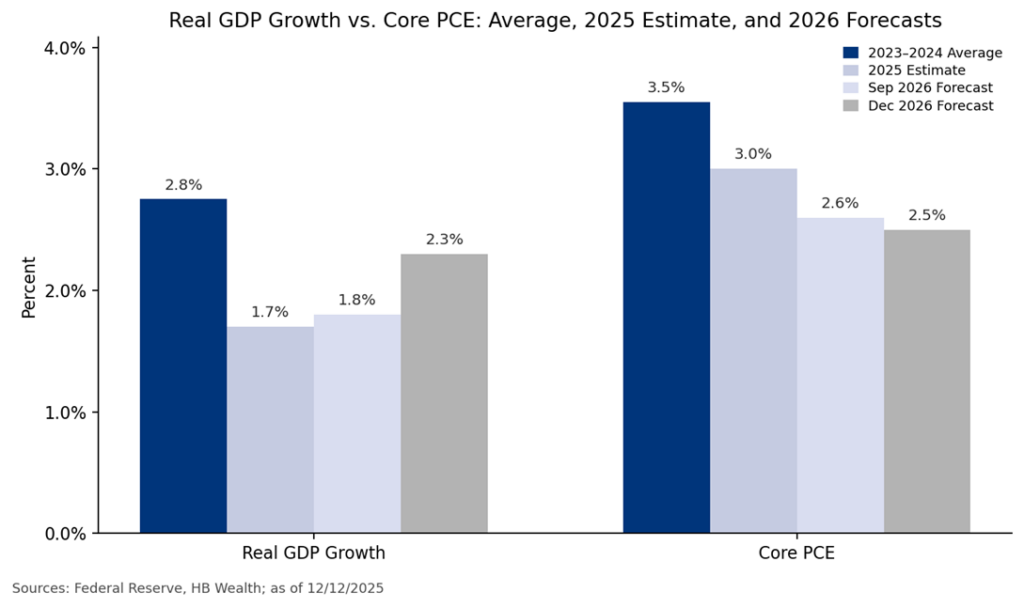
Though the Fed reduced rates at their meeting this week, the better news for stocks might be found in their forecast for growth and inflation. Growth is now expected to accelerate while inflation eases in the year ahead. The median estimate suggests a GDP gain of 2.3% next year, a full half point faster than the September forecast for 1.8%, and core inflation is expected to rise 2.5% in the year ahead, less than the September projection for 2.6%. This implies GDP growth recovery to near pre-2025 norms and the lowest inflation figure since 2020.
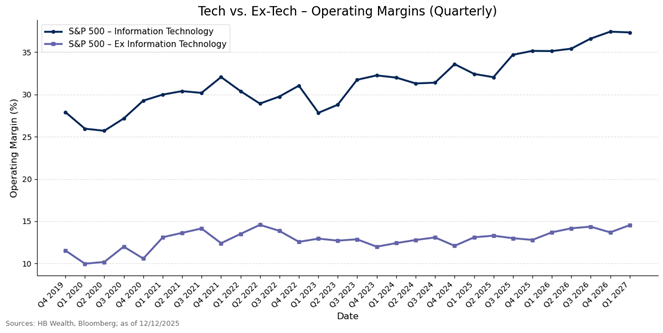
For the last several years, tech has been the primary beneficiary of productivity gains, resulting in a two-speed margin landscape for the S&P 500, and contributing to concentration risk in both earnings and prices. However, if stronger growth and lower inflation emerge, it may imply a broader recovery for S&P 500 margins.
Currently the consensus anticipates the status quo will remain in 2026 – tech is expected to record much faster margin expansion the rest of the S&P 500. Margins for tech have surged past former peaks over the last year and are expected to continue to rise to new highs by the end of 2026. Meanwhile, only modest improvement in ex-tech margins is forecasted to levels last recorded at the 2022 high. If the Fed is right and productivity gains emerge in the year ahead, presumably partly because technological advancements start to benefit non-tech industry productivity more broadly, margins may improve more than expected for non-tech companies. This margin recovery for non-tech companies could help ease the concentration risk that has plagued the index for the last several years, strengthening the fundamental backdrop for US stocks.
Disclosure: The information reflects the author’s views, opinions, and analyses as the publication date. The information is provided for informational purposes only and does not constitute an offer to sell or a solicitation of an offer to buy any investment product. This information contains forward-looking statements, predictions, and forecasts (“forward-looking statements”) concerning the belief and opinions in respect to the future. Forward-looking statements involve risks and uncertainties, and undue reliance should not be placed on them. There can be no assurance that forward-looking statements will prove to be accurate, and actual results and future events could differ materially from those anticipated in such statements. The information does not represent legal, tax, accounting, or investment advice; recipients should consult their respective advisors regarding such matters. Certain information herein is based on third-party sources believed to be reliable, but which have not been independently verified. Past performance is not a guarantee or indicator of future results; inherent in any investment is the risk of loss.