








Even Without an Ease, The Fed is Still Easy

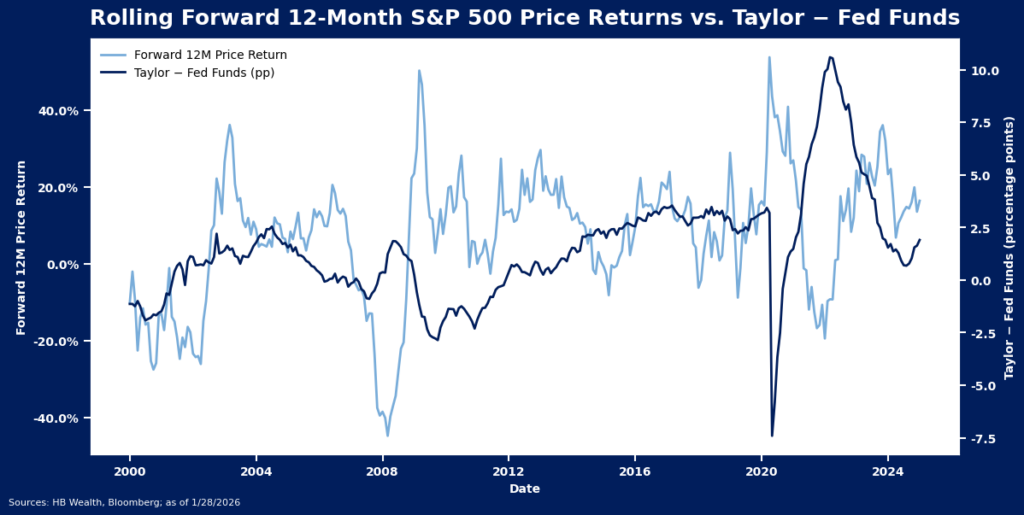
Line chart showing rolling forward 12-month S&P 500 price returns (dark blue) and Taylor–Fed Funds rate difference (light blue) from 2000 to 2024, with both series fluctuating but rarely moving in sync.

The FOMC paused rate cuts in January, with stabilizing labor markets and inflation pressures offering little reason to ease more at the current time. They didn’t need to ease more to stay easy anyway – after three consecutive declines in the benchmark rate in late 2025 the Taylor rule suggests policy is in accommodative territory. The spread between the Taylor rule and Fed funds is north of 2% currently, above its 25-year average of 1.5.

Stocks may not like the move much – we estimated earlier this year that equities were holding out hope for up to 4 cuts to emerge this year, and that seems increasingly unlikely.  However, the current level of accommodation still sets a positive backdrop for equities.  The market has averaged a 8.4% forward 12-month return when policy was accommodative (Fed funds rate below the rate implied by the Taylor rule), and a 4.5% forward 12-month return when policy was restrictive (Fed funds above).
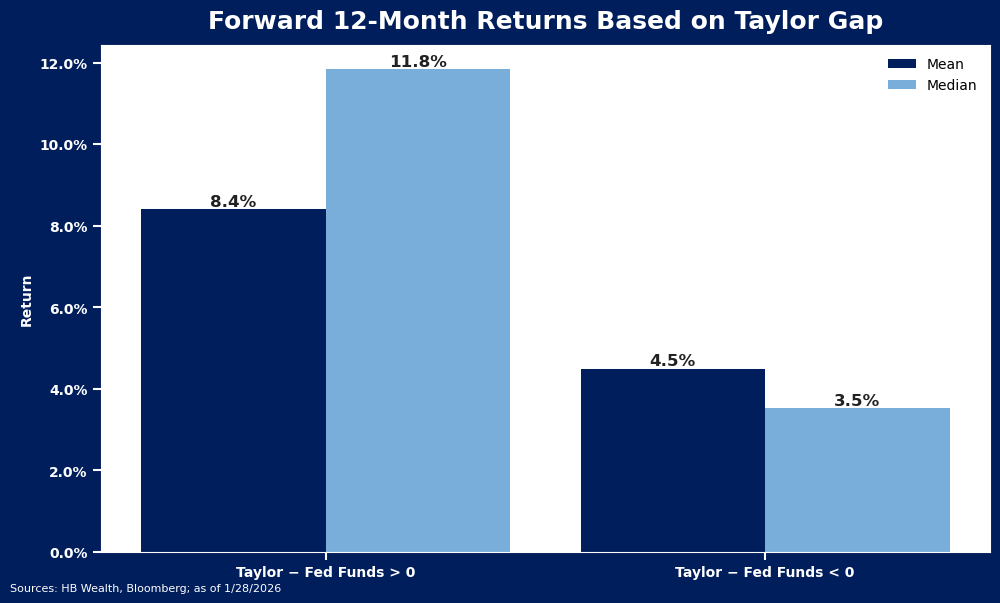
Bar chart titled Forward 12-Month Returns Based on Taylor Gap showing returns for “Taylor - Fed Funds > 0” (Mean: 8.4%, Median: 11.8%) and “Taylor - Fed Funds < 0” (Mean: 4.5%, Median: 3.5%).

The Fed did leave some hints in the post-meeting statement regarding what they may need to see to resume easing in future months. Policymakers said the “unemployment rate has shown some signs of stabilization”. This contrasts language in the last three statements that pointed to downside risks to employment as a concern and suggests jobs figures may have the biggest sway in future policy decisions.

With the Fed meeting now in the past, the market will quickly turn its attention back to earnings as a primary driver of prices in the near term. Mega cap tech stocks face lofty expectations for near 30% growth in 2026 and will need to justify those expectations to keep stocks powering higher. 

Disclosure: HB Wealth is an SEC‑registered investment adviser. The information reflects the author’s views, opinions, and analyses as the publication date. The information is provided for informational purposes only and does not constitute an offer to sell or a solicitation of an offer to buy any investment product. This information contains forward-looking statements, predictions, and forecasts (“forward-looking statements”) concerning the belief and opinions in respect to the future. Forward-looking statements involve risks and uncertainties, and undue reliance should not be placed on them. There can be no assurance that forward-looking statements will prove to be accurate, and actual results and future events could differ materially from those anticipated in such statements. The information does not represent legal, tax, accounting, or investment advice; recipients should consult their respective advisors regarding such matters. Certain information herein is based on third-party sources believed to be reliable, but which have not been independently verified. Past performance is not a guarantee or indicator of future results; inherent in any investment is the risk of loss.

A woman with long brown hair wearing a blue blazer and a necklace smiles at the camera. The background is softly blurred with light and blue tones.

Gina Martin Adams, CFA, CMT

Chief Market Strategist, Shareholder

Gina Martin Adams, CFA, CMT, is the Chief Market Strategist for HB Wealth. With more than 25 years of experience at leading global financial institutions, Adams brings deep expertise in market analysis, thematic research, and translating complex economic trends into actionable strategies. She collaborates with HB Wealth’s investment team to deliver timely market perspectives, share actionable insights, and enhance the firm’s visibility as a leading voice in the industry. She contributes to advancing proprietary research, supporting the development of new investment products, and enhancing the client experience through thought leadership and education. She pursues a top-down perspective and model-based approach, leveraging fundamental, technical, and quantitative perspectives to inform investment decisions, and frequently presents her views in the media and at industry conferences, professional associations and investment organizations.

A young man with short brown hair, wearing a dark suit, white shirt, and blue tie, stands in front of a blurred background with lights and blue tones.

Matthew Sanders

Senior Investment Research Analyst

Related Insights & News

Don’t Ignore Inflation Risk in 2026

Elevated fiscal spending, easy monetary policy, trade tensions and geopolitical strains may imply inflation risk…

Read More

Tech’s Time Close to the Sun May Be Ending, and It Means a New Market Landscape

U.S. equity markets’ rotation out of technology has come a long way over the last…

Read More

Stocks are Expensive – What Does That Mean for Returns?

U.S. large cap stocks ended 2025 in rare valuations territory, with the cyclically adjusted PE…

Read More

Gold and Silver are Glittering Like its 1979

Metals prices are breaking records so far in 2026, hitting new all-time price highs and…

Read More

The above is not a recommendation to purchase or sell a particular security and is not legal, investment or tax advice. Results are not guaranteed. All investing involves risk.

Past performance is not a guarantee of future results for any investment. Private alternative investments are not for every client. An individual must be qualified to invest in a private investment based on their net worth and/or other criteria, and they may qualify to invest in some alternative investments while not being allowed to invest in other alternative investments. Alternative investments are not risk-free and there is no guarantee of achieving attractive performance compared to similar liquid investments. Risks associated with investments in private alternatives include the illiquid nature of such investments, risks associated with leveraged investments, manager-specific risks, sector-specific risks, and in certain cases geographical risk, as well as the risk of loss of principal.